While I was preparing an augment for this week's History of Art & Design II lecture on the Fin de siècle, I spent some rather enjoyable hours looking through various sites that offer images of natural history illustration in the late nineteenth century. I'd already been inspired by the Haeckel book mentioned on my last post, and in addition to the various pages devoted to his work, I also happened on the New York Public Library's Digital Image Library and its collection of drawings by the French astronomer Étienne Léopold Trouvelot (1827-1895). The images are of chromolithographs produced from drawings Trouvelot made while observing such heavenly bodies as the moon and Mars.
The drawing of the moon is quite fanciful and suggestive of the Art Nouveau designs that would shortly follow in France, England, Austria, and other parts of the Continent:
 A crater on the moon was later named after Trouvelot:
 Compare Trouvelot's almost floral interpretation with Galileo's drawing of what he saw, alongside a photo of the spot:
 Trouvelot's image of Mars almost suggests an embryo, but it's quite simple to understand how he came to his conclusions about what his telescope showed him, because I get an image close to this when I look through my very basic backyard model:
 The drawing records his observation at a precise moment: September 3, 1877, at 11 hrs. 55 min. P. M.
My favorite image Wunderkammer, Wikimedia Commons, produced some interesting and varied finds under the general rubric of science illustration. You really need to search using "science" as your keyword, because the illustrations show up under general topics such as "biology" (which would eventually lead you to Haeckel) or "astronomy." Looking through the Commons catalogue under "armillary sphere" in "history of astronomy" (under "astronomy"), for example, produced a lovely scan of Utagawa Kinuyoshi's Chinese Astronomer 1685. When it ran as Wikimedia's "Picture of the Day" it proved to be so popular that it was nominated for "Picture of the Year" for 2006.
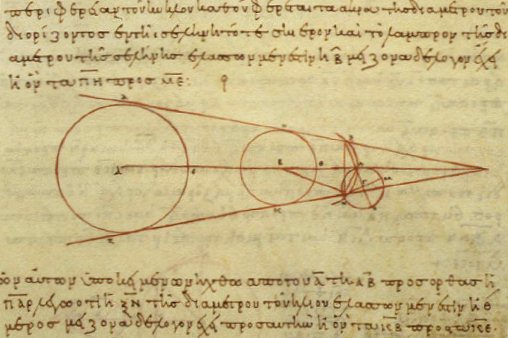
 There are also numerous diagrams from periods throughout history. These are often simple, elegant, and accurate--especially considering the lack of all the technological bells and whistles we have access to today. One of these is a 10th century CE Greek copy of calculations made by Aristachus of Samos (in the second century BCE) of the relative sizes of the sun, moon, and Earth:
 Another drawing, by the Arab astronomer Nasir Al-Din Tusi, illustrates what's now known as a Tusi-couple, used to depict an aspect of planetary motion that Ptolemy described in his convoluted equant theory. Together with its clarity, and the elegance of the Arabic script, it combines calligraphic elements that exemplify good solid graphic design principles still in place.
 I should probably end with what was one of my favorite discoveries of all--Tito Lessi's painting of Galileo and Viviani from 1892.
 It's a wonderful emblem of the interest in science evident in nineteenth-century Europe that had a huge impact on the development of art and design, especially in terms of subject matter. I only hope that by introducing my students to the existence of this fascination they can play around with some of these sources and makes some discoveries of their own.
Photo credit: in addition to the images I've already credited, the first one I include is Universum, a montage by Camille Flammaron for the 1880 edition of his work, Popular Astronomy.