Showing posts with label collections. Show all posts

Monday, August 3, 2026

Domestic Stratigraphy

Note: I originally wrote this for Owl's Farm, but then realized that it's just the thing needed to relaunch Owl's Cabinet of Wonders.

"Vallies" by Orra White Hitchcock

We had a bit of a reprieve yesterday in terms of temperature, so I settled in the study, without the air con and only a small fan to blow the air about a bit. Out of doors it was only 93F with a little breeze, so I pottered around in the garden with Molly in the morning and got some things that needed doing done.

But the previous night had been a long one, during which time I stewed and mused about all the things I haven't been getting done and my fuzzy brain landed on my vast collection of stuff, the origins of my tendency to Not Let Go, and what might still be done about it before my time runs out. 

I realized that although I come from a long line of quasi-hoarders, I tend be rather orderly about it: lots of boxes and bins, mostly catalogued and labeled, tucked away into nooks and crannies, the many closets that populate the house, the attic, the garage, and book cases in which books share space with collections of Supplies. No teetering stacks of old newspapers and pizza boxes ready to do us in, like in a Midsomer Murders episode. We once thought that my mother's family were examples of nominative determinism since Hoard was her father's last name, but realized that it's really just an aptonym).

The last year's distractions had kept me from executing the full implementation of my Swedish Death Cleaning enterprise, and the recent adoption of Alan into the household has resulted in the arbitrary inclusion in the Snug closet of shredded plush toys, chewed-up cushions, torn puppy blankets, and sentimentally preserved objects left over from previous beloved dogs. So, atop the boxed-up stuff lie new layers of all that. 

The Museum of Unfinished Projects (AKA the hall closet) also has stuff piled atop the otherwise well-sorted goods, so there is now what seems like the equivalent of a shipping container's worth of goods to be gone through. I've attempted to make it more useful several times, and even wrote a blog post about that once (the link is to a previous post on the Cabinet). Fortunately, it's too hot to even think about dealing with the attic, the garage, the old garden shed, and the greenhouse/Wunderkammer. 

In a little-understood fit of soul-less destructive energy, last week I very quickly went through at least ten years of New Yorker magazines that had been stashed in piles atop an old steamer trunk (maternal great grandmother's) that spends its time on the screened-in porch off our living room. I saved a few covers, plus a few a random articles or cartoons accidentally encountered during the two or three hours total it took me to get through those piles, and a few crosswords. All the rest went into the recycle bin, and what was saved amounted only to about a two-inch stack.
 

Now on the porch there's only left the final boxing up of things for the charity shop, and if the weather holds for another day, that can be taken care of as well. I'm now awaiting a similarly ruthless spell to allow me to toss the uncountable number of dollars' worth of dog toy remnants we've acquired just since Alan joined us at the end of October of last year.

As difficult as it is for me to deal with all the accumulated detritus of my life, I refuse to take full responsibility for the affliction. The genes that made me into an historian/geologist/archaeologist/story teller/reader and whatever else I've become, came from both sides of my family, and I learned packrattery from the best of instructors. My favorite place to visit when I returned to the US in 1962 was my Grandmother's house in Lone Pine and, more specifically, her garage--which I'm pretty sure had never been occupied by an actual car. She also had closets in the house, one of which held a couple of shelves of potential Pinochle tournament prizes, but nothing was nearly as interesting as the contents of that garage: ancient Paiute baskets given her by tribal women she knew while she was growing up in Big Pine; sound equipment from my grandfather's days as a square dance caller; cigar boxes of potsherds and obsidian arrow points; toys left over from her childhood and those of her own children, trunks of treasures I can't even remember specifically, but do remember sifting through, accompanied by her explanations of the contents. My last trip back to her house when she was 99 and moving to a rest home in Bishop, involved helping her son and her niece load up my rental car with mementos large (the metal lawn chairs we sat in to stargaze during summer visits and the Singer treadle sewing machine on which I learned) and small (one of the cigar boxes that held artifacts I later used during archaeology lectures).

A considerable amount of what occupies my own garage involves the remains of several Very Large Boxes shipped to my mother from her incredibly kind and indulgent benefactor, the late Fr. Bartley Scmitz, SVD, of Chiayi, Taiwan. When she was deported for a long-expired visa in the late '90s, Fr. Schmitz boxed up collections of photographs, photocopies, tear-sheets, negatives, household goods, clothing, and innumerable tchotchkes that she had accumulated when she returned to the island in the  '80s. I've found homes for some of the historically useful images. but haven't yet had the gumption to go through the rest.  But I can sense a rift in the sentimental logjam if only a break in the weather will occur before I succumb to the call of the genes and the remnants of whatever came over me last week fade entirely.

The difference between my garage and that of the fondly-remembered one in my father's mother's back yard is that Gram's held some fairly interesting bits of family history that had been preserved in the desert climate of the Owens River Valley. North Texas, on the other hand, with its dank moldiness and suffocatingly humid summers contributes only nesting materials for displaced wildlife. As long as I keep that in mind, I should be able to bag up what needs to go, and finally turn it into a facsimile of Joseph Cornell's (in)famous collection of potentially useful creative inspiration. Unfortunately, Faithful Readers, you'll have to make do with my lame approximations of his shelves of assorted inspirational materials (like "love letters to Jennifer Jones, unanswered" if I remember correctly). My post on Garden Wunderkammern was recently flagged by the Blogger Authorities as containing some manner of contraband, which may have involved copyrighted materials.  So I'm providing a list of potentially interesting and inspiring media sources (books and websites) and showing you a snippet of what lurks in my hundred-plus year-old house's not-quite-as-old garage:


Including more would have involved more sophisticated photo-editing skills than I now possess, but there are two tall Skandia shelves worth of miscellaneous boxes and objects that I plan to make use of for something someday.

Well. I've finally done it. Thanks for encouragement from Tim and others who wrote, and followers who didn't strike me from their rolls during my long hiatuses.

Stay cool, People. Even those of you in Massachusetts won't be immune from the heat for long.


Image notes and resources:

The stratigraphic drawing at the beginning of the post is from the Public Domain Review's archive article,  "Orra White Hitchcock's Scientific Illustrations for the Classroom, 1828-40." I still don't know how to use Procreate well enough to build my own images for these posts, so until I do, I'll joyfully plunder the PDR's marvelous sources.

Some years ago I obtained a terrific multi-media facsimile of Joseph Cornell's Manual of Marvels, in a lovely box, with a disc, published by Thames & Hudson. I've linked the New York Times article about it, by Julie Bloom, which I can now do without your having to pay for it. The link, that is. The book/object will set you back at least 45USD used.

Deborah Solomon's biography, Utopia Parkway: The Life & Work of Joseph Cornell, is widely available at physical bookshops--HPB and other independents. And at my other favorite place to donate money (besides Wikipedia and The Public Domain Review), the Internet Archive. 


Monday, July 10, 2017

Still Living

Over the last few weeks I've mostly been loafing and contemplating the universe, enjoying The Beloved Spouse's summer holiday and the unusual reasonableness of the weather. Most mornings or late afternoons I can take an hour or so to read in the hammock we've installed in the back yard, a good command post for observing snoozing animals and working through the many stacks of books I've piled here and there with the intention of getting to at last. Trouble is, I accumulate more before I finish the ones I have in process, so the piles aren't getting any shorter. 

We did, however, make time to invite family over for brunch last Sunday, which meant getting the house tidied up, and as I went through the rooms hoovering away I kept noticing how still life compositions turn up everywhere. I'm not really sure how conscious they are, stemming as they do from the desire to put things out that remind me of our lives: rocks, shells, books, tchotchkes, photos, and other bits of memorabilia. The phenomenon is unmistakable, however. An eighteenth-century Dutch painter could make something of these little tableaux.

When I was still teaching, I'd spend a fair amount of time in art history classes pointing out the ubiquity of still lifes among the works of almost any artist one could study. This genre reaches an apex during the Baroque, of course, especially among the Dutch, but it's really everywhere--and everywhen--throughout the history of human creative endeavor. Although denigrated by nineteenth-century art historians as less important or indicative of talent and imagination than history painting, these visual Wunderkammern appear with increasing frequency after Roman mural paintings started filling the walls of villas in Pompeii and Herculaneum. 

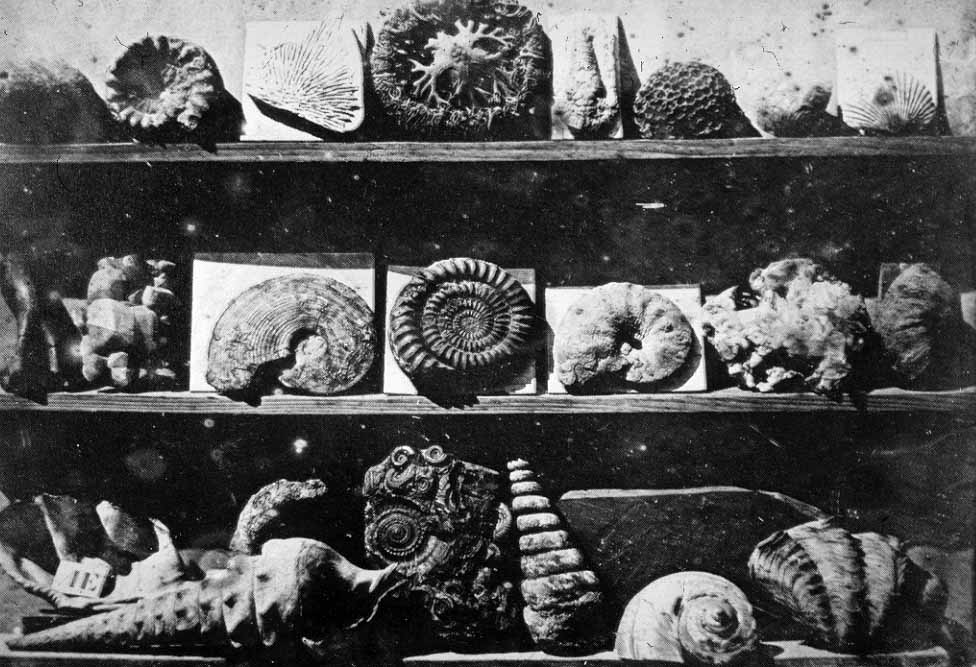
Early photographers must have been grateful for the very stillness of the still life because of the long exposure times the  technology initially required, and Louis Daguerre's wonderful studio photos of assorted objects or shelves of fossils mimic the painted compositions of found objects popular among the collectors of the nineteenth century. My favorite examples for students were these:


Louis Jacques Mande Daguerre, Shells and Fossils 1839

Alexandre-Isidore Leroy De Barde, Selection of Shells Arranged on Shelves (before 1828)

A couple of years ago I participated in a MOOC offered by Cal Arts called "Live!: A History of Art for Artists, Animators and Gamers." One of my favorite assignments involved creating a "world in a box" and my submission, called This Is Not a Baroque Still Life, looked like this:


Sorry about the quality of the image, but I'm too lazy to take it into Photoshop to make it look prettier. According to my concept statement, "I tried to include items associated with traditional still life compositions, but with anachronistic elements (like the nineteenth-century photo) as well. An emptied bookshelf provided the frame." Had I been more religious about the composition, I'd have made it more three-dimensional by hanging some bits off the edge, but the components were fairly appropriate. Perhaps some day I'll try painting it and bring the process full circle.

To get back to my original notion behind this post, the tendency to create compositions like this seems to be a major aspect of how we embellish our homes. I hesitate to say "decorate," because I'm not sure that the urge to surround ourselves with objects is fundamentally about prettying things up (which what decoration suggests to me)--but rather about memory. The things I stash on surfaces (book cases, sideboards, tables, even windowsills) are things that remind me of people and places I have loved. They're not all just visual, either. When I picked up a bowl of desert holly this morning (I needed its normal resting place yesterday to hold brunchy things and had stashed it atop the china cabinet), its scent immediately took me back to Owens Valley, where I'd (probably illegally) picked it to bring back to Texas.

The increasingly sophisticated photo apps on smart phones is making it possible to record my little domestic museums, and to play with them in various ways. I'm amused that what I'm doing with my iPhone camera these days is something like what I had my students do in my History of Art and Design classes many years ago. The original assignment was for them to photograph a still life we composed in class (using a digital camera that recorded the image on a 3.5" floppy disc!) and then to manipulate it in Photoshop to make it look like the work of a particular artist or designer. I still have several of these stashed away, and perhaps some day I'll resurrect them and feature a collection of student work on the Cabinet. But here's what a simple app (probably Old Photo Pro or Vintique) did to a shot of one of my window sill collections:


I'm not sure why I don't have the original orientation in my library any more, but the idea's still evident (and including the spiderwebs was intentional). The objects all hold a bit of meaning: a dried gourd from an early garden at this house, an old clay pipe from my misspent youth, a Kokeshi doll (part of a collection from my childhood years in Japan), a ceramic cat that belonged to my mother, and an incense dish with little lead figures (a hut, a crab, a boat) designed for use with bonsai arrangements. It occurs to me only now that the background actually records a version of our north yard that no longer exists--the ladder having since almost disintegrated and been moved to behind the garage, and the pots on the fence having been broken by some large feral intruder only a few days ago. The objects have been placed more or less randomly and are occasionally cycled in and out of the grouping, as is the custom in Japan. A display (although I hesitate to call this sort of randomness a real "display") in a Japanese tokonoma is thoughtfully and purposefully arranged to set a mood or to show off a prized group of possessions, usually fewer than what I typically include in my more accidental collections.

Creating still life compositions seems to be an innate tendency in people all over the world, and perhaps this activity reflects fundamental cultural needs--for memory, reflection, contemplation, or even ostentation: personal Wunderkammern archiving moments in individual lives. I wish I had noticed this before I stopped teaching, because I probably could have gotten more mileage out of the concept had I realized how fundamental the idea of composing personal items into meaningful assemblages is to our creative lives.

Image credits: The Daguerre and Leroy de Barde works are included via Wikimedia Commons. The rest are my own.


Friday, July 1, 2011

The Green Life

Every now and then, out of vanity, curiosity, or fear (I'm not sure which), I Google myself to find out if anyone is using my name in vain.

Usually what comes up are posts from the Farm or here--as well as the ubiquitous "rate your professor" sites (my hotness factor is, alas, still zero). Once in a while, however, somebody will quote me and refer to one of the posts. I'm usually happy for the exposure, and occasionally join the conversation. It's rare, however, that I happen upon something truly wonderful.

I pinched the above image from an internal visual journal, Vita Viridis (Green Life), published by some clearly like-minded folk who work at one or more of the Harvard University Herbaria. There are only a few available online--volume 1 number 5 (from whence I obtained the page that includes a letter I wrote to the editors of Orion magazine some time ago), volume 1 issue 2, and issue 3, in living color and .pdf format so they can be enjoyed in all their visual splendor.

I love this idea so much that I'm going to try something similar with my myth class this spring--a sort of in-class journal of stuff they write and create (the great thing about teaching in an art school is that you can actually ask students to do this and they will), and things they find that they think apply in one way or another. It'll be a one-off venture, but we can scan and share among ourselves--and perhaps with readers of the Cabinet.

Anyway, the real treasure here is not the "me" part, but the discovery of the Herbaria pages themselves. As an inveterate plant lover, erstwhile amateur naturalist (who can still identify every one of the eighteen "official" trees on her half acre, as well as all the volunteers that now occupy various corners of the Carbon Sink), Old China Hand, and certified museum junkie, this site offers nearly everything.

For example, check out the Digital Collections of such wonders as the SHIP initiative (images of seeds in the collection of the Arnold Arboretum) and links to the expedition collections of Joseph F. C. Rock, who explored the "Hengduan Mountains Hotspot" in western Sichuan and eastern Xizang (Tibet), China. I especially love the Arnold Arboretum Image Collection, which contains historical photos taken in the "Hotspot" region during the early twentieth century.

The website offers a mere glimpse into the richness of Harvard's collections, but since I didn't have any idea of their extent (and only vaguely knew of the herbaria at all), this amounts to a truly serendipitous find.