Showing posts with label memory. Show all posts

Monday, July 10, 2017

Still Living

Over the last few weeks I've mostly been loafing and contemplating the universe, enjoying The Beloved Spouse's summer holiday and the unusual reasonableness of the weather. Most mornings or late afternoons I can take an hour or so to read in the hammock we've installed in the back yard, a good command post for observing snoozing animals and working through the many stacks of books I've piled here and there with the intention of getting to at last. Trouble is, I accumulate more before I finish the ones I have in process, so the piles aren't getting any shorter. 

We did, however, make time to invite family over for brunch last Sunday, which meant getting the house tidied up, and as I went through the rooms hoovering away I kept noticing how still life compositions turn up everywhere. I'm not really sure how conscious they are, stemming as they do from the desire to put things out that remind me of our lives: rocks, shells, books, tchotchkes, photos, and other bits of memorabilia. The phenomenon is unmistakable, however. An eighteenth-century Dutch painter could make something of these little tableaux.

When I was still teaching, I'd spend a fair amount of time in art history classes pointing out the ubiquity of still lifes among the works of almost any artist one could study. This genre reaches an apex during the Baroque, of course, especially among the Dutch, but it's really everywhere--and everywhen--throughout the history of human creative endeavor. Although denigrated by nineteenth-century art historians as less important or indicative of talent and imagination than history painting, these visual Wunderkammern appear with increasing frequency after Roman mural paintings started filling the walls of villas in Pompeii and Herculaneum. 

Early photographers must have been grateful for the very stillness of the still life because of the long exposure times the  technology initially required, and Louis Daguerre's wonderful studio photos of assorted objects or shelves of fossils mimic the painted compositions of found objects popular among the collectors of the nineteenth century. My favorite examples for students were these:
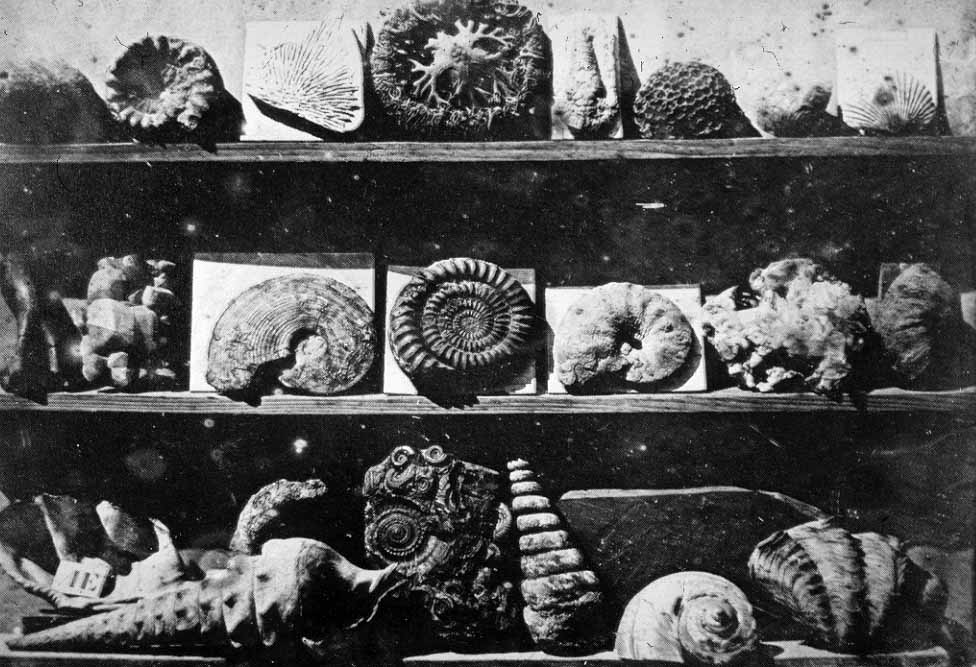

Louis Jacques Mande Daguerre, Shells and Fossils 1839

Alexandre-Isidore Leroy De Barde, Selection of Shells Arranged on Shelves (before 1828)

A couple of years ago I participated in a MOOC offered by Cal Arts called "Live!: A History of Art for Artists, Animators and Gamers." One of my favorite assignments involved creating a "world in a box" and my submission, called This Is Not a Baroque Still Life, looked like this:


Sorry about the quality of the image, but I'm too lazy to take it into Photoshop to make it look prettier. According to my concept statement, "I tried to include items associated with traditional still life compositions, but with anachronistic elements (like the nineteenth-century photo) as well. An emptied bookshelf provided the frame." Had I been more religious about the composition, I'd have made it more three-dimensional by hanging some bits off the edge, but the components were fairly appropriate. Perhaps some day I'll try painting it and bring the process full circle.

To get back to my original notion behind this post, the tendency to create compositions like this seems to be a major aspect of how we embellish our homes. I hesitate to say "decorate," because I'm not sure that the urge to surround ourselves with objects is fundamentally about prettying things up (which what decoration suggests to me)--but rather about memory. The things I stash on surfaces (book cases, sideboards, tables, even windowsills) are things that remind me of people and places I have loved. They're not all just visual, either. When I picked up a bowl of desert holly this morning (I needed its normal resting place yesterday to hold brunchy things and had stashed it atop the china cabinet), its scent immediately took me back to Owens Valley, where I'd (probably illegally) picked it to bring back to Texas.

The increasingly sophisticated photo apps on smart phones is making it possible to record my little domestic museums, and to play with them in various ways. I'm amused that what I'm doing with my iPhone camera these days is something like what I had my students do in my History of Art and Design classes many years ago. The original assignment was for them to photograph a still life we composed in class (using a digital camera that recorded the image on a 3.5" floppy disc!) and then to manipulate it in Photoshop to make it look like the work of a particular artist or designer. I still have several of these stashed away, and perhaps some day I'll resurrect them and feature a collection of student work on the Cabinet. But here's what a simple app (probably Old Photo Pro or Vintique) did to a shot of one of my window sill collections:


I'm not sure why I don't have the original orientation in my library any more, but the idea's still evident (and including the spiderwebs was intentional). The objects all hold a bit of meaning: a dried gourd from an early garden at this house, an old clay pipe from my misspent youth, a Kokeshi doll (part of a collection from my childhood years in Japan), a ceramic cat that belonged to my mother, and an incense dish with little lead figures (a hut, a crab, a boat) designed for use with bonsai arrangements. It occurs to me only now that the background actually records a version of our north yard that no longer exists--the ladder having since almost disintegrated and been moved to behind the garage, and the pots on the fence having been broken by some large feral intruder only a few days ago. The objects have been placed more or less randomly and are occasionally cycled in and out of the grouping, as is the custom in Japan. A display (although I hesitate to call this sort of randomness a real "display") in a Japanese tokonoma is thoughtfully and purposefully arranged to set a mood or to show off a prized group of possessions, usually fewer than what I typically include in my more accidental collections.

Creating still life compositions seems to be an innate tendency in people all over the world, and perhaps this activity reflects fundamental cultural needs--for memory, reflection, contemplation, or even ostentation: personal Wunderkammern archiving moments in individual lives. I wish I had noticed this before I stopped teaching, because I probably could have gotten more mileage out of the concept had I realized how fundamental the idea of composing personal items into meaningful assemblages is to our creative lives.

Image credits: The Daguerre and Leroy de Barde works are included via Wikimedia Commons. The rest are my own.


Tuesday, October 28, 2008

Days of the Dead

Before I moved to Texas, my end-of-October celebratory experience was limited to Halloween, which lost its fascination quickly after I started getting serious about health and environmental issues, and after my kids had outgrown (I thought) dressing up like Han Solo and fairy princesses. I am, of course, completely wrong about that, since I'm pretty sure they both gleefully dress up as video game characters or Sex in the City types on a regular basis. But I've gone a bit bah-humbug on the candy-giving/costuming mania over the past few years. We've handed out treats only once since we moved to this neighborhood; mostly we keep the porch light off and hunker down to watch a movie with the curtains drawn.

I still do like the idea of celebrating the dead, but I'm not sure that scoring pounds of candy is the most poetic way of doing it. The last time I "dressed up" I wore a white Victorian nightgown and pasty white makeup and drifted about the trails of the Heard Museum, a nearby nature center, to frighten paying guests. But that was over twenty years ago. More recently, I've grown fond of local Day of the Dead festivities, and of the lovely sugar skulls and crepe-paper colors, and the music that floats down the street when folks from our local barrio drive by on their way to the highway.

My grandmother was a great one for remembering those who'd gone before, but her ceremonies (which included gathering up every stray flower in the yard into a couple of buckets of water) focused on the family plot in Big Pine, on Memorial Day. Once or twice we drove up on Veterans Day to put flowers on my grandfather's grave, but Day of the Dead wasn't in our vocabulary then, despite the fact that the Valley was home to a fairly large population of second- and third- (and probably more than a few fourth-) generation Mexican immigrants.

Outside my hometown lies an old, mostly-forgotten graveyard with only a few headstones left, some engraved in Spanish, some in Russian. I've never pursued the sources of the graves, but maybe this would be a good time to do so. Sometimes we'd visit the site when I took the kids to see Grandma, and we'd go out and walk among the graves on a hot summer evening. The setting sun always made the scene a bit eerie, and once (about twenty five years ago) I took the picture here--of my daughter in her nightie next to one of the headstones that had fallen over (or had been pushed) and then cracked.

An aside: Following my own instructions (issued to my students only yesterday) to follow any question that arises with research, I conducted a quick search on Owens Valley graves and found this through Google Books (it refers to the very gravestone beside which my daughter is standing in the photo):

Josefa de Alday's tombstone reads, 'Your children wish to remember the proof of the great love they had for you.' In 1880, Josefa was 40 years old and living in Inyo County wth two children. The D. E. P. at the bottom of her stone means 'rest in peace.'

From Cemeteries of the Eastern Sierra, p. 119
by Gena Philibert-Ortega

Now, in exile far from familiar graves and family bones, I've taken to enjoying what goes on locally. This year, at least one of my Visual Anthropology group projects will involve Día de los Muertos celebrations in town. The last time I taught the class was during the fall quarter a year ago, and one team visited a street party in Fort Worth to record Cowtown's version of the Day of the Dead. Because it involves community and tradition, it's a natural subject for anthropology in the first place, and an especially good topic if the focus is on recording it on film. These two guys took lovely pictures of the festivities and exhibits. This picture that opens this post is from those taken for the project.

Holidays like All Saints' and All Souls' days have roots in far more ancient traditions than the Christian beliefs that finally embraced them. Celebrating Los Días de los Muertos is itself a hybrid of Aztec and Christian views of the dead and of the afterlife, just as Halloween marries Christian and pagan rituals. I'm not sure why I now enjoy the Day of the Dead idea so much more than Halloween, except that the focus on remembrance (rather than on greed?) reassures me that when my remains have been scattered in the Sierras, or buried under a tree in an eco-cemetery somewhere, somebody might build a little altar in my honor, with pictures of things I loved and a little sugar skull. At least I'll know that nobody will be posing their daughter next to my tombstone!

Photo credit: Thanks to Alex Antonio and Drew Simon for the great picture and for inspiring the direction of the post.

Monday, May 26, 2008

Coffee, Tea, Madeleines, and Memory

Every morning of my life, my first cup of coffee reminds me of my grandmother, and the year I spent with her after I returned from five years in Taiwan, and while I waited for my father to return from his posting in England.

Gram always got up before me, even on school days, and made coffee. None of the fancy stuff--Maxwell House out of a can--and no fancy brewing technique--just a Farberware percolator. The results were strong and aromatic: coffee smell. I'd almost invariably wake up then, and join her for a cup liberally doused with milk and (then) laced with sugar; it was probably more like "coffee milk" with which my other grandmother treated me almost from infancy, with a bit of doughnut for dunking. I gradually weaned myself from the sugar (Gram drank hers black), but never could do without the milk.

I'm always amused, too, when I go to Starbucks these days for my usual nonfat latte and occasionally grab a pack of madeleines for the trip to school. This combination almost always leads to my turning off the radio and letting my mind go wherever it wants to, instead of listening to NPR for news on the latest catastrophic event.

So Proust's tea-and-madeleine experience is essentially universal, although most people are not eloquent enough to write huge tomes about memories that engage readers for nearly a century. He died the year after my father was born, and the year my house was built (I'm great at finding connections that mean absolutely nothing).

This morning, the combination of fresh coffee (freshly-ground Ruta Maya organic, filtered through a Cuisinart into a carafe that keeps it hot but doesn't over-cook it; still, my tastes have changed very little) and the memory of my grandmother carried me further: to her Memorial Day tradition of gathering flowers and taking them from her house to the family plot in the Big Pine cemetery, thirty miles north. Gram didn't care for cut flowers in the house, claiming that they were better off and would last longer in the garden where they belonged, but on Memorial Day she'd pick everything then blooming: sweet peas, honeysuckle, trumpet vine, and put them in a huge bucket with enough water to keep them from wilting during the trip.

I can still remember the ride north, with the windows open in the Chevy ('57, I think; she later got herself a souped up Chevy Nova). In the high desert, mornings are cool and crisp no matter how hot it gets later in the day. By the time we left the cemetery, it was already warming up, and we were tempted to stay there under the trees. But there were always things to get done, so after a couple of hours of stories about folks buried there, we headed home and the ride back was a little quieter than the ride up. Although I didn't live with her after that year, except during summer vacations, I made the Memorial Day trip several other times during my life, and I'm pretty sure we took my children once--even though they were probably too young then to remember. They've been back, of course, when we buried her ashes and later those of my father. And my one true regret in life now is that I don't live close enough to go up there every year with flowers for her.

On this memorial day, I wanted to note my family's "collection" of veterans in that cemetery. Thanks to Ancestry.com, I've now got access to various military records that help fill in some gaps, and I recommend that folks take advantage of this treasure trove if they've got vets of their own.

My father's father, Ira Uhlmeyer, fought in World War I, and his participation in that particular war made possible my enrollment at the University of California, Riverside. I received a La Verne Noyes Scholarship, available only to direct descendants of veterans of WWI. Were it not for that scholarship, I doubt if I'd been able to spend the summer working in my home town (for less than minimum wage at a local frosty shop), and would have had to find better-paying work nearer the college. As it was, I got by with the summer gig in Lone Pine, and a work-study job on campus. At any rate, here's my grandfather's draft card (click for a larger view):

My father, Thomas William Uhlmeyer, served in the Army Air Corps during the second World War, and later joined the newly formed U. S. Air Force and served during both the Korean and Viet Nam "conflicts." He retired after 23 years as a Senior Master Sergeant, never having had the ambition to become an officer because he loved what he did and going to officer candidate school would require changing jobs. Always the raconteur, Daddy wrote down his Pacific theater experiences in WWII, and as soon as I get my scanner working, I'll start publishing them here--complete with pictures.

My cousin Eddie Uhlmeyer (eldest son of grandfather's brother Charles) joined the Army during Viet Nam, but was stationed in Germany for most of his enlistment. He died in an auto accident not long after his discharge, and is also buried in the Big Pine cemetery. Eddie and I got to know one another the summer before I started college, and I still miss him. Like most Uhlmeyer men, he had a terrific sense of humor and was fun to be around.

And so today, as I linger over my coffee, I'm remembering these three men in particular, as well as Ralph Hoard (mentioned previously). I may be a pacifist under the skin, but even those of us who think there are better ways to solve problems than by killing one another appreciate the job our soldiers have done on our behalf. Many of my current students are Iraq and Afghanistan vets. I'm glad they made it back, and I worry every day about the ones who are still "over there." Another of my students recently lost her brother in Iraq, and I can only begin to imagine what today must be like for her family. But as long as people haven't managed to figure out how to keep political conflicts from erupting into war, and as long as we remain mortal, remembering our dead one day a year is the least we can do.

I hope somebody's remembering Proust today, too.

Photos: My grandfather's draft card, courtesy Ancestry.com; Proust's grave in the Père-Lachaise cemetery in Paris, taken by Paul Louis, from Wikimedia Commons.

Tuesday, May 6, 2008

Family Archaeology

One problem with being old, and being the child of a family of packrats, is that one not only accumulates a large amount of stuff, but the stuff is not only one's own--it's often the legacy of others.

And then there's the problem of having an overactive imagination, one that's constantly coming up with ideas about what can be done with this or that bit of stuff. So that stuff gets collected. And so do things that can be recycled into other things.

Ultimately it all ends up in one or two places in my house. Visits to IKEA have produced a few strong cardboard boxes in nice colors to hold some of it. Those items sit attractively on shelves in bookcases. The rest ends up in closets--specifically one in the study, and in another we've dubbed The Museum of Unfinished Projects. This latter spot is a wonderful space, designed almost like a pantry, with room for a dresser or storage unit under shelves that start about halfway up the wall on two sides. I've got a small bookcase on one wall, which holds an almost complete collection of Martha Stewart Living, several years' worth of Old House Journal, and a more random stack of This Old House. Martha will no longer arrive at my house when my subscription runs out next year, but I find it difficult to toss what I've got.

In the back of the closet, under the deep shelves, I've got two rolling wire carts that hold hanging files. One of these belonged to my husband during his bachelor days, and another was a gift from him and my children on the first Mother's Day we were together. Now they hold tearsheets from magazines--one for articles on food and recipes, another for "ideas"--home repair, craft instructions, inspiration, etc.

Boxes on the shelves contain memorabilia (mostly from my children's growing-up years) and fabric for quilts long since abandoned. Other unfinished efforts include a stuffed pteradactyl, some paper dragons I was going to hang in my son's room after I'd painted them, bereft baskets of embroidery, tins of buttons, bags of pillow stuffing, and boxes of reparable items of too much sentimental value to be discarded.

The closet in the study holds boxes of old photographs and letters, most of these from my mother's family, but a large bag of photos was added about five years ago, when my father sat down with me and went through stacks of family pictures before he died. Since I wasn't ready to admit that he was actually dying at the time, I neglected to ask as many questions as I should have done.

One of the things I've noticed about blogging is that it helps to focus one's energies on tasks at hand. Because the Museum of Unfinished Projects houses a number of collections, it will probably provide blog fodder for at least a few months, and if nothing else, blogging about hunting and gathering should encourage me to sort and consider its contents. If this in fact occurs, I may accomplish something even more important: ensuring that my children aren't left with the task after I've shuffled off.

On the other hand, the very act of sorting through the family midden is an exercise in connection, context, and history. Old photographs, memorabilia from experiences not our own, correspondence, well-loved objects--all of these generate memory, stir the imagination, and provide hints about where we are and how we got here.

In his novel, Howard's End, E. M. Forster utters the memorable injunction, "Only connect"--connect the prose with the passon, connect the fragments, create wholeness. This is in part what we do when we look back at the material remains of our pasts and the pasts of our ancestors. It's probably what makes archaeology a necessary profession in a world otherwise consumed with modernity. It may also explain interest in museums and Wunderkammern: images and objects that connect the very distant past (both on a human and a geological scale) with the present. Excavation and classificaton are acts of history, memory, and connection.

Let the dig begin.

Photo: The Museum of Unfinished Projects