
Over the last few weeks I've mostly been loafing and contemplating the universe, enjoying The Beloved Spouse's summer holiday and the unusual reasonableness of the weather. Most mornings or late afternoons I can take an hour or so to read in the hammock we've installed in the back yard, a good command post for observing snoozing animals and working through the many stacks of books I've piled here and there with the intention of getting to at last. Trouble is, I accumulate more before I finish the ones I have in process, so the piles aren't getting any shorter.
We did, however, make time to invite family over for brunch last Sunday, which meant getting the house tidied up, and as I went through the rooms hoovering away I kept noticing how still life compositions turn up everywhere. I'm not really sure how conscious they are, stemming as they do from the desire to put things out that remind me of our lives: rocks, shells, books, tchotchkes, photos, and other bits of memorabilia. The phenomenon is unmistakable, however. An eighteenth-century Dutch painter could make something of these little tableaux.
When I was still teaching, I'd spend a fair amount of time in art history classes pointing out the ubiquity of still lifes among the works of almost any artist one could study. This genre reaches an apex during the Baroque, of course, especially among the Dutch, but it's really everywhere--and everywhen--throughout the history of human creative endeavor. Although denigrated by nineteenth-century art historians as less important or indicative of talent and imagination than history painting, these visual Wunderkammern appear with increasing frequency after Roman mural paintings started filling the walls of villas in Pompeii and Herculaneum.
Early photographers must have been grateful for the very stillness of the still life because of the long exposure times the technology initially required, and Louis Daguerre's wonderful studio photos of assorted objects or shelves of fossils mimic the painted compositions of found objects popular among the collectors of the nineteenth century. My favorite examples for students were these:
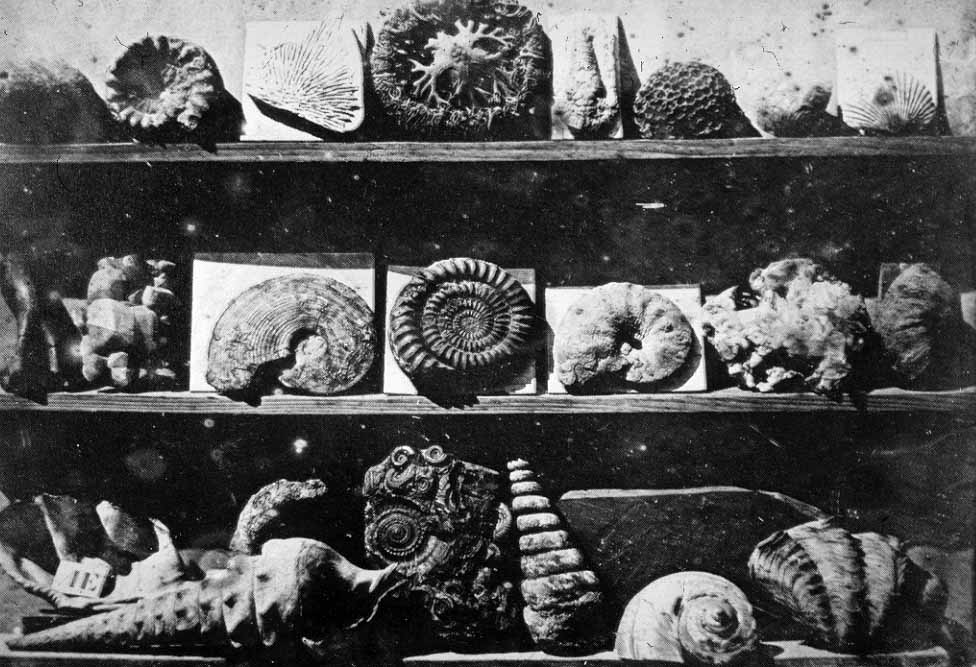
Louis Jacques Mande Daguerre, Shells and Fossils 1839

Alexandre-Isidore Leroy De Barde, Selection of Shells Arranged on Shelves (before 1828)
A couple of years ago I participated in a MOOC offered by Cal Arts called "Live!:
A History of Art for Artists, Animators and Gamers." One of my favorite assignments involved creating a "world in a box" and my submission, called This Is Not a Baroque Still Life, looked like this:

Sorry about the quality of the image, but I'm too lazy to take it into Photoshop to make it look prettier. According to my concept statement, "I tried to include items associated with traditional still life compositions, but with anachronistic elements (like the nineteenth-century photo) as well. An emptied bookshelf provided the frame." Had I been more religious about the composition, I'd have made it more three-dimensional by hanging some bits off the edge, but the components were fairly appropriate. Perhaps some day I'll try painting it and bring the process full circle.
To get back to my original notion behind this post, the tendency to create compositions like this seems to be a major aspect of how we embellish our homes. I hesitate to say "decorate," because I'm not sure that the urge to surround ourselves with objects is fundamentally about prettying things up (which what decoration suggests to me)--but rather about memory. The things I stash on surfaces (book cases, sideboards, tables, even windowsills) are things that remind me of people and places I have loved. They're not all just visual, either. When I picked up a bowl of desert holly this morning (I needed its normal resting place yesterday to hold brunchy things and had stashed it atop the china cabinet), its scent immediately took me back to Owens Valley, where I'd (probably illegally) picked it to bring back to Texas.
The increasingly sophisticated photo apps on smart phones is making it possible to record my little domestic museums, and to play with them in various ways. I'm amused that what I'm doing with my iPhone camera these days is something like what I had my students do in my History of Art and Design classes many years ago. The original assignment was for them to photograph a still life we composed in class (using a digital camera that recorded the image on a 3.5" floppy disc!) and then to manipulate it in Photoshop to make it look like the work of a particular artist or designer. I still have several of these stashed away, and perhaps some day I'll resurrect them and feature a collection of student work on the Cabinet. But here's what a simple app (probably Old Photo Pro or Vintique) did to a shot of one of my window sill collections:


I'm not sure why I don't have the original orientation in my library any more, but the idea's still evident (and including the spiderwebs was intentional). The objects all hold a bit of meaning: a dried gourd from an early garden at this house, an old clay pipe from my misspent youth, a Kokeshi doll (part of a collection from my childhood years in Japan), a ceramic cat that belonged to my mother, and an incense dish with little lead figures (a hut, a crab, a boat) designed for use with bonsai arrangements. It occurs to me only now that the background actually records a version of our north yard that no longer exists--the ladder having since almost disintegrated and been moved to behind the garage, and the pots on the fence having been broken by some large feral intruder only a few days ago. The objects have been placed more or less randomly and are occasionally cycled in and out of the grouping, as is the custom in Japan. A display (although I hesitate to call this sort of randomness a real "display") in a Japanese tokonoma is thoughtfully and purposefully arranged to set a mood or to show off a prized group of possessions, usually fewer than what I typically include in my more accidental collections.
Creating still life compositions seems to be an innate tendency in people all over the world, and perhaps this activity reflects fundamental cultural needs--for memory, reflection, contemplation, or even ostentation: personal Wunderkammern archiving moments in individual lives. I wish I had noticed this before I stopped teaching, because I probably could have gotten more mileage out of the concept had I realized how fundamental the idea of composing personal items into meaningful assemblages is to our creative lives.
Image credits: The Daguerre and Leroy de Barde works are included via Wikimedia Commons. The rest are my own.

