Showing posts with label Art and Science. Show all posts
Sunday, May 19, 2013
Glass, Art, and Science
I guess posting once a year or so is better than not posting at all, but probably not much. It's not that I don't ever think about Cabinet-appropriate things; in fact, stuff falls into my radar range fairly frequently, but I use the "I'm too busy" card, probably way too often.
Sometimes, though, something irresistible appears and lights a fire under my backside, as this video and article from the New York Times did this week: In Pursuit of an Underwater Menagerie. It's about a new exhibit featuring glass models of marine creatures created by Leopold and Rudolf Blaschka, and the curator's effort to locate living examples.
The nineteenth-century father-and-son team from Germany found the perfect way to produce models of transparent and translucent creatures. Traditional means (watercolor drawings, primarily, but also wax and other sculptural materials) lost some of the delicacy of sea creatures, but Leopold's "glass-spinning" technique (vulgarized in many a seaside tourist gift shop) allowed the Blaschkas to produce amazingly lifelike replicas.
The sheer (and the pun is intended), alien beauty of these creatures and their glass counterparts is nowhere more apparent than in the Times interactive feature, Glass Mirrors Life in the Seas.
Cornell University's Albert R. Mann Library houses the Cornell Collection of Blaschka Invertebrate Models, and its Gallery includes 34 pages of photographs (there's also a slideshow linked on the Gallery page). The Wikipedia article on the Blaschkas is also helpful (and includes a few photos), if you've never heard of the pair before.
For more photos (differently mounted), see London's Natural History Museum page, and the National Museum of Wales.
The Blaschkas might actually be better known for their plant models, in the Ware Collection of Blaschka Glass Models of Plants at Harvard. For a nice history of the botanical models, see the Corning Museum of Glass video, The Story of Rudolf and Leopold Blaschka:
One wonders how much more interest children would show in the natural world if they were to be introduced to plants and animals through a combination of first-hand experience (when possible) and beautifully rendered visual works that capture the essence of the life-form. I can only hope that the new Perot science museum in Dallas will try to mount an exhibit of the Blaschkas' work, and perhaps generate an interest in the relationship between art and science embodied by their glass models.
Image credit: Bougainvillea species, from the Zoological Museum of Strasbourg, photo by Ji-Elle via Wikimedia Commons.
Friday, August 8, 2008
Heavenly Visions
While I was preparing an augment for this week's History of Art & Design II lecture on the Fin de siècle, I spent some rather enjoyable hours looking through various sites that offer images of natural history illustration in the late nineteenth century. I'd already been inspired by the Haeckel book mentioned on my last post, and in addition to the various pages devoted to his work, I also happened on the New York Public Library's Digital Image Library and its collection of drawings by the French astronomer Étienne Léopold Trouvelot (1827-1895). The images are of chromolithographs produced from drawings Trouvelot made while observing such heavenly bodies as the moon and Mars.The drawing of the moon is quite fanciful and suggestive of the Art Nouveau designs that would shortly follow in France, England, Austria, and other parts of the Continent:
A crater on the moon was later named after Trouvelot:
Compare Trouvelot's almost floral interpretation with Galileo's drawing of what he saw, alongside a photo of the spot:
Trouvelot's image of Mars almost suggests an embryo, but it's quite simple to understand how he came to his conclusions about what his telescope showed him, because I get an image close to this when I look through my very basic backyard model:
The drawing records his observation at a precise moment: September 3, 1877, at 11 hrs. 55 min. P. M.My favorite image Wunderkammer, Wikimedia Commons, produced some interesting and varied finds under the general rubric of science illustration. You really need to search using "science" as your keyword, because the illustrations show up under general topics such as "biology" (which would eventually lead you to Haeckel) or "astronomy." Looking through the Commons catalogue under "armillary sphere" in "history of astronomy" (under "astronomy"), for example, produced a lovely scan of Utagawa Kinuyoshi's Chinese Astronomer 1685. When it ran as Wikimedia's "Picture of the Day" it proved to be so popular that it was nominated for "Picture of the Year" for 2006.
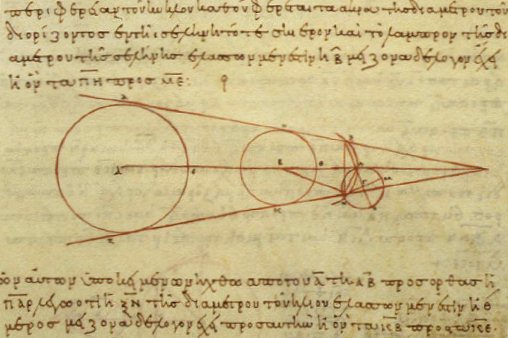
There are also numerous diagrams from periods throughout history. These are often simple, elegant, and accurate--especially considering the lack of all the technological bells and whistles we have access to today. One of these is a 10th century CE Greek copy of calculations made by Aristachus of Samos (in the second century BCE) of the relative sizes of the sun, moon, and Earth:
Another drawing, by the Arab astronomer Nasir Al-Din Tusi, illustrates what's now known as a Tusi-couple, used to depict an aspect of planetary motion that Ptolemy described in his convoluted equant theory. Together with its clarity, and the elegance of the Arabic script, it combines calligraphic elements that exemplify good solid graphic design principles still in place.
I should probably end with what was one of my favorite discoveries of all--Tito Lessi's painting of Galileo and Viviani from 1892.
It's a wonderful emblem of the interest in science evident in nineteenth-century Europe that had a huge impact on the development of art and design, especially in terms of subject matter. I only hope that by introducing my students to the existence of this fascination they can play around with some of these sources and makes some discoveries of their own.Photo credit: in addition to the images I've already credited, the first one I include is Universum, a montage by Camille Flammaron for the 1880 edition of his work, Popular Astronomy.
Labels:
Art and Science,
astronomy,
scientific illustration
Friday, June 27, 2008
Wikimedia Wunderkammer
Not that I need anything to occupy my time, since there seems to be so little of it these days, but I've been meaning to sing the praises of Wikimedia Commons ever since I started using it on a regular basis. Today's post will, I hope, be the first on the many wonders I've encountered there, and perhaps encourage my small coterie of readers to see what the Commons has to offer.I have to admit that I was a reluctant convert to Wikipedia, because my students insist on using it as their first (and often last) source when conducting research. It's not that I have anything against Wikipedia itself, but it's an encyclopedia--a terrific instrument for school-age kids, but limited in actual content (my rule is: use primary sources first, whenever possible). But Wikipedia also lists multitudes of auxiliary sources, both in print and online, that can lead a student in productive directions, so although I still won't let them include it in a bibliography, I don't mind their consulting it for further information.
Yesterday, while engaging in one of my seemingly random web searches--this one on the nineteenth-century evolutionary biologist and artist, Ernst Haeckel--I discovered that the Commons contains the plates from the 1904 edition of his Kunstformen der Natur (Artforms of nature). The Wikipedia article on Haeckel had linked this collection, as well as some other really interesting web pages devoted to his work. Beloved Spouse was busy using a drum sander in our soon-to-be study, so I had time on my hands and went exploring.
In addition to an animated film about Haeckel's work, called Proteus, which I'll be ordering for our college library, the Wikipedia "external links" list included one to some gorgeous alpha channel transparencies of images from Kunstformen, by media artist Scott Draves, who links an online copy of the book, in German, with an index to all of the plates and a large-format .pdf version.
Inspired by what happened yesterday, today I went to the Commons home page and clicked on "Nature: Animalia" and then on "Mollusca: Gastropoda" and then on "Fossil Gastropods." Since I'm interested in natural forms and human design motifs, I figured that this would be a good place to look for spiral forms in nature for use in a new lecture in History of Art and Design I. Sure enough, there were scads of lovely photos--all available as public domain images or contributed under sharing licenses by a variety of good-hearted folk who, like me, might think that "intellectual" and "property" are mutually problematic ideas. I love the idea of the Creative Commons licenses, under one of which I published More News From Nowhere; I figure that anybody who might be even remotely interested in it shouldn't have to pay for it, especially given the novel's philosophical focus. Not that I don't think people should be paid for their work, but when ideas are floating around all over the place it seems absurd to start copyrighting and patenting stuff that's been out there for eons.At any rate, I recommend meandering through the Wikimedia Commons at your leisure. I have found lovely photos to use on my blogs, such as those featured in today's post, and am happy to attribute them whenever possible. I'll probably start uploading some of my stuff, rather than trying to make a buck out of a lucky shot by putting it up on a stock photo sharing company site (even though it's the next best thing to the Commons, and one of my favorite former students works for one such outfit--so here's a plug, Lesa: istockphoto.com).
But now I have to get back to rehabbing our old house, and the business of sanding corners on my hands and knees. It's a lot more fun to go messing about among quaint and/or interesting topics and pictures, though, so I'll undoubtedly be doing so again soon.
Addendum, 24 July 2008: While making my weekly pilgrimage to the "new" section of the Kelley Library yesterday, I noticed--prominently displayed among the "check this out" selections--an absolutely gorgeous volume of Haeckel's work: Visions of Nature: The Art and Science of Ernst Haeckel (Munich: Prestel, 2006). This is a terrific addition to our collection, and one that (once they can get their hands on it) should inspire a whole new generation of students. But I'm not giving it up until after the weekend, when I'll have a chance to drool over the magnificent photos of Haeckel's study and his own private collection of interesting oddities--as well as the wealth of beautifully reproduced prints. Oh, and there's actual information included in here, too!
Photo credits: Ernst Haeckel, Ammonitida (Ammonite), Wikimedia Commons. Thalamophora, from Kunstformen der Natur by Ernst Haeckel, .png file by Scott Draves. Viviparus glacialis; Borehole Rosmalen, Netherlands; Pleistocene: Late Tiglian, taken by Tom Meijer (PaleoMal), Wikimedia Commons.
Subscribe to:
Posts (Atom)