Monday, August 3, 2026

Domestic Stratigraphy

Note: I originally wrote this for Owl's Farm, but then realized that it's just the thing needed to relaunch Owl's Cabinet of Wonders.

"Vallies" by Orra White Hitchcock

We had a bit of a reprieve yesterday in terms of temperature, so I settled in the study, without the air con and only a small fan to blow the air about a bit. Out of doors it was only 93F with a little breeze, so I pottered around in the garden with Molly in the morning and got some things that needed doing done.

But the previous night had been a long one, during which time I stewed and mused about all the things I haven't been getting done and my fuzzy brain landed on my vast collection of stuff, the origins of my tendency to Not Let Go, and what might still be done about it before my time runs out. 

I realized that although I come from a long line of quasi-hoarders, I tend be rather orderly about it: lots of boxes and bins, mostly catalogued and labeled, tucked away into nooks and crannies, the many closets that populate the house, the attic, the garage, and book cases in which books share space with collections of Supplies. No teetering stacks of old newspapers and pizza boxes ready to do us in, like in a Midsomer Murders episode. We once thought that my mother's family were examples of nominative determinism since Hoard was her father's last name, but realized that it's really just an aptonym).

The last year's distractions had kept me from executing the full implementation of my Swedish Death Cleaning enterprise, and the recent adoption of Alan into the household has resulted in the arbitrary inclusion in the Snug closet of shredded plush toys, chewed-up cushions, torn puppy blankets, and sentimentally preserved objects left over from previous beloved dogs. So, atop the boxed-up stuff lie new layers of all that

The Museum of Unfinished Projects (AKA the hall closet) also has stuff piled atop the otherwise well-sorted goods, so there is now what seems like the equivalent of a shipping container's worth of goods to be gone through. I've attempted to make it more useful several times, and even wrote a blog post about that once (the link is to a previous post on the Cabinet). Fortunately, it's too hot to even think about dealing with the attic, the garage, the old garden shed, and the greenhouse/Wunderkammer

In a little-understood fit of soul-less destructive energy, last week I very quickly went through at least ten years of New Yorker magazines that had been stashed in piles atop an old steamer trunk (maternal great grandmother's) that spends its time on the screened-in porch off our living room. I saved a few covers, plus a few a random articles or cartoons accidentally encountered during the two or three hours total it took me to get through those piles, and a few crosswords. All the rest went into the recycle bin, and what was saved amounted only to about a two-inch stack.
 

Now on the porch there's only left the final boxing up of things for the charity shop, and if the weather holds for another day, that can be taken care of as well. I'm now awaiting a similarly ruthless spell to allow me to toss the uncountable number of dollars' worth of dog toy remnants we've acquired just since Alan joined us at the end of October of last year.

As difficult as it is for me to deal with all the accumulated detritus of my life, I refuse to take full responsibility for the affliction. The genes that made me into an historian/geologist/archaeologist/story teller/reader and whatever else I've become, came from both sides of my family, and I learned packrattery from the best of instructors. My favorite place to visit when I returned to the US in 1962 was my Grandmother's house in Lone Pine and, more specifically, her garage--which I'm pretty sure had never been occupied by an actual car. She also had closets in the house, one of which held a couple of shelves of potential Pinochle tournament prizes, but nothing was nearly as interesting as the contents of that garage: ancient Paiute baskets given her by tribal women she knew while she was growing up in Big Pine; sound equipment from my grandfather's days as a square dance caller; cigar boxes of potsherds and obsidian arrow points; toys left over from her childhood and those of her own children, trunks of treasures I can't even remember specifically, but do remember sifting through, accompanied by her explanations of the contents. My last trip back to her house when she was 99 and moving to a rest home in Bishop, involved helping her son and her niece load up my rental car with mementos large (the metal lawn chairs we sat in to stargaze during summer visits and the Singer treadle sewing machine on which I learned) and small (one of the cigar boxes that held artifacts I later used during archaeology lectures).

A considerable amount of what occupies my own garage involves the remains of several Very Large Boxes shipped to my mother from her incredibly kind and indulgent benefactor, the late Fr. Bartley Scmitz, SVD, of Chiayi, Taiwan. When she was deported for a long-expired visa in the late '90s, Fr. Schmitz boxed up collections of photographs, photocopies, tear-sheets, negatives, household goods, clothing, and innumerable tchotchkes that she had accumulated when she returned to the island in the  '80s. I've found homes for some of the historically useful images. but haven't yet had the gumption to go through the rest.  But I can sense a rift in the sentimental logjam if only a break in the weather will occur before I succumb to the call of the genes and the remnants of whatever came over me last week fade entirely.

The difference between my garage and that of the fondly-remembered one in my father's mother's back yard is that Gram's held some fairly interesting bits of family history that had been preserved in the desert climate of the Owens River Valley. North Texas, on the other hand, with its dank moldiness and suffocatingly humid summers contributes only nesting materials for displaced wildlife. As long as I keep that in mind, I should be able to bag up what needs to go, and finally turn it into a facsimile of Joseph Cornell's (in)famous collection of potentially useful creative inspiration. Unfortunately, Faithful Readers, you'll have to make do with my lame approximations of his shelves of assorted inspirational materials (like "love letters to Jennifer Jones, unanswered" if I remember correctly). My post on Garden Wunderkammern was recently flagged by the Blogger Authorities as containing some manner of contraband, which may have involved copyrighted materials.  So I'm providing a list of potentially interesting and inspiring media sources (books and websites) and showing you a snippet of what lurks in my hundred-plus year-old house's not-quite-as-old garage:


Including more would have involved more sophisticated photo-editing skills than I now possess, but there are two tall Skandia shelves worth of miscellaneous boxes and objects that I plan to make use of for something someday.

Well. I've finally done it. Thanks for encouragement from Tim and others who wrote, and followers who didn't strike me from their rolls during my long hiatuses.

Stay cool, People. Even those of you in Massachusetts won't be immune from the heat for long.


Image notes and resources:

The stratigraphic drawing at the beginning of the post is from the Public Domain Review's archive article,  "Orra White Hitchcock's Scientific Illustrations for the Classroom, 1828-40." I still don't know how to use Procreate well enough to build my own images for these posts, so until I do, I'll joyfully plunder the PDR's marvelous sources.

Some years ago I obtained a terrific multi-media facsimile of Joseph Cornell's Manual of Marvels, in a lovely box, with a disc, published by Thames & Hudson. I've linked the New York Times article about it, by Julie Bloom, which I can now do without your having to pay for it. The link, that is. The book/object will set you back at least 45USD used.

Deborah Solomon's biography, Utopia Parkway: The Life & Work of Joseph Cornell, is widely available at physical bookshops--HPB and other independents. And at my other favorite place to donate money (besides Wikipedia and The Public Domain Review), the Internet Archive


Monday, July 13, 2026

Just A Note

In an effort to resuscitate and coördinate my various online efforts, I'm redesigning most of my existing content.

Attempts at doing so recur every few years, and usually fail, but this time I think things might work out. I'm now planning to spend the rest of the endless north Texas summer in my air-conditioned study trying to get my act back together while my cognitive marbles are still rolling around in my aging noggin.

Once again, please bear with me. A new banner is currently under construction, and a new post in the works.

Monday, June 20, 2022

Creating a Garden Wunderkammer


Just when I think that it's finally time to retire the Cabinet, something inspires me to keep it going. This time it was the dual decision to clean up my little greenhouse and to begin to sort through some of the detritus in our shed (and, eventually, as part of the ongoing Swedish Death Cleaning project, the garage). It occurred to me that some of the stuff we've gathered over the years, throughout our lives and travels, is kind of interesting. This could all result in a personal Gesamtkunstwerk. Or if not something so grand, at least my own Wunderkammer.

Almost by accident, but not entirely, much of this accumulation has ended up in the wonderful little polycarb greenhouse The Beloved Spouse erected for me back in early November of 2020. Visitors to Owl's Farm have glimpsed it occasionally (as on Earth Day of this year), but I've never really given it the attention it deserves. Things get plonked down in there willy nilly, and only sometimes somewhat artfully (as above).

Since its inception, this little structure has seen us through two winters (including the one marked by Snowmageddon in February of 2021), and has ended up housing the various bits of geological, biological, and cultural memorabilia collected on two trips out west, and several visits to more local destinations in several Texas state parks and Corps of Engineers campgrounds. 

So now I think it's time to let the combined inspirations of Rosamund Purcell and William Buckminster guide my creative juices and turn the as-yet unnamed greenhouse/potting shed/spider and anole habitat into something worthy of its simple structure and basic usefulness. The only thing it's not really good for is being a greenhouse. Our winters are becoming increasingly cold, and we haven't figured out an earth-friendly way to heat it. It's also too efficient at producing solar heat during the day support seed-starting. Only a couple of the plants we harbored in it over winter survived (and they would have done had we simply left them alone out of doors). At the moment we're leaving it open all day and all night because temperatures approach 150F by noon and don't cool off until very early in the morning (with both of its vents wide open).

This project will take some time, so here is some homework if 1) anybody's still reading this blog and 2) you're at all interested in my inspirations.

Rosamond Purcell is a photographer and artist who has published several books of her work and has collaborated with the late paleontologist and geologist Stephen Jay Gould on three books that illustrate the relationship between art and science. William Buckminster was the owner of a seven-acre mass of discarded who-knows-what near Owls Head, Maine, that Purcell frequently visited--and from which she excavated materials for some of the most idiosyncratic and creative works imaginable. I came upon her work early in my teaching career, and mined her creative output as exemplars to inspire my many art and design students. Long before "upcycling" became a "thing," Purcell was using found objects and finds from Owls Head (and museum collections and other sources) to create multimedia works. So for those of who unfamiliar with her accomplishments, here are some recommendations:

Crossing Over: Where Art and Science Meet, by Stephen Jay Gould and Rosamond Wolff Purcell. (2000) New York: Three Rivers Press. Essays by Gould, illustrations by Purcell. 

Owls Head: On the Nature of Lost Things, by Rosamond Purcell. (2003) New York: Quantuck Lane Press (The link is to a 2004 Fresh Air interview on NPR conducted by Terry Gross; the images don't work any more, but the discussion is terrific.)

Bookworm, by Rosamond Purcell. (2006) New York: Quantuck Lane Press.

More on this project will follow soon. 

Note (07.14.26) I've removed most of the links on this page because I seem to have inadvertently violated somebody's copyright and Blogger removed this post. So you'll have to do your own searches for books or articles mentioned until I find less offensive ways to make my sources available.

Thursday, April 22, 2021

Earth Day 2021: A Collection of Earth Friendly Zines

I thought I'd celebrate Earth Day by providing a little collection of inspiring publications that help keep my spirits up. All are are available digitally through Zinio and other electronic clearinghouses, and none of them are from around here. Most of these center on permaculture, regenerative grazing, sustainability, reducing waste, and other means to accomplishing tikkun olam (the Jewish concept of healing the world).

Still a lover of print, I nevertheless welcome the chance to read well-produced digital versions of magazines I could never afford in print, and would have a really hard time letting go of. The beauty of electronic versions is that I can archive them and they don't stack up in piles on bookshelves--like my favorite house porn journal, Country Living UK (which I now get on Zinio).


The first is a lovely little gem from the UK that sounds like one of those "clean up your stuff" mags that spend too much time suggesting that you buy stuff to keep your stuff in. The Simple Things is, however, more of an inspirational foray into craft and nature from the UK that urges a simplified life but doesn't necessarily require that one immediately go out to the shops or head for Amazon, although it does frequently feature sustainably crafted goods.

The May issue includes an article on "Almost-wild" camping, which sounds like it could catch on in the US. Unfortunately, I didn't ask for permission to include the image here, so it's been removed. But do look it up. 

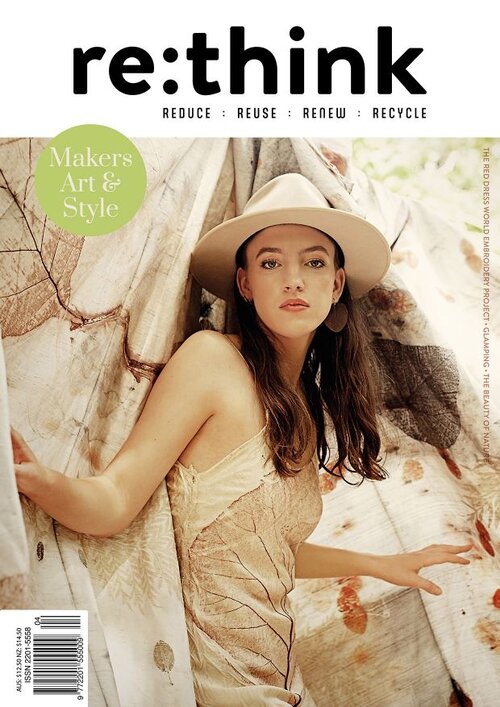
A year or so back I discovered a charming--and inspiring--magazine on Zinio called Junkies, which soon after changed its name to a less problematic and more appropriate re:think.

Published in Australia, it focuses on recycling, making, sustainable fashion, and a range of related topics. 

Every time I read an issue of this magazine, I imagine new ways to use things that in another life I would have thrown out. That alone is worth the subscription price.

Like many magazines, print or digital, Re:Think seems to be having some publication difficulties, and I'm still waiting for the next issue.

Note: I'm beginning to worry that this may not have made it through the pandemic; but I continue to hope.


Rather than things, this Australian publication focuses on philosophical and cultural issues, and especially on people "with the drive to make a difference" around the world.

Dumbo Feather's current issue's topic is Truth, and navigating the problematic world of information.

Several conversations are featured each issue, with interesting and inspiring people I might never have heard of if I hadn't  happened on this journal.


Pip. Australia has been the axis mundi of permaculture practice and development for years. In 2014, Robin Rosenfeldt moved to New South Wales and began a magazine designed to provide "ideas and inspiration for a resilient future." Pip is a congenial, information-packed quarterly with evocative artwork and articles on sustainability, growing, eating, building, and thriving. The website has some wonderful videos and advice about living lightly on the planet

Another quarterly Australian publication, Earth Garden might remind some folks of the US's Mother Earth News (to which I also subscribe digitally) but can confuse a whole lot of us in the northern hemisphere because of its seasonal focus. 

Sustainable living is once again the driving force, with an emphasis on gardening and dealing with the output. 

Terrific gardening and farming ideas, great recipes, solid advice on house-holding techniques (like canning and preserving) are all to be found within its pages.


Their high production values, collective ethical and cultural conscience (the Australian magazines acknowledge their debt to the indigenous peoples on whose land they create and publish), optimism, and practical suggestions for rehabilitating and sustaining the planet, make these all worth taking a look at. 

Happy Earth Day, folks. Stay well, get vaccinated, and help to save the planet.

[Note: edited on 06.20.22. I apologize for the problematic page design: spacing trouble.]

Monday, March 15, 2021

Pi Day Pear Pie


Because my attention span is pretty limited these days, my posts are generally confined to The Farm. I keep promising to keep the Cabinet up and running, but am seldom successful.

This year, however, I've vowed to channel some of my current optimism into more concerted efforts at posting on both blogs, confining my rants on political economy and garden angst to The Farm, and explorations of a more ephemeral nature to this space. And what, to a pie lover, could be more ephemeral than pie? And yes, I know that Pi Day was yesterday (3.14), but I was so knackered after baking the pie that I didn't have enough steam left for blogging about it.

But of course there's a story, so here it is. A couple of months ago, I received word from my longtime e-mail provider, a former student who runs a business that manages such things, that he was moving to a Microsoft 365 platform and changes would have to be made. But since I don't know from Microsoft almost anything (despite the fact that My Son The Game Guy works for the company), I decided to cut and run. I laboriously moved all my contacts over to gmail, and copied volumes of letters to and from family and friends. This was not an entirely unenjoyable effort, because I was able to skim quite a number of letters that brought back memories of the last twenty years. There's further work to do, such as sorting letters by person, and extracting each correspondent from his or her spot in a much larger file to a more manageable one.

Among those whose letters I most value is my uncle Art. He is my father's youngest brother, and the only one of my paternal grandparents' children still living. At nearly 87, he's the family patriarch, and because of good clean living, a terrific sense of humor, a fabulous wife and family, and his mother's longevity genes, I hope he'll hold that title for at least another twenty years. 

When I began blogging in 2007, Art started letting me know what he thought about what I was writing, and one project I look forward to is going back through those letters and compiling them with my responses and the posts to which they're related.  Of course, I'll have to live another thirty years or so to get all that done, because both sides of my family have been copious correspondents, and both my grandmother and I saved one another's letters (for about forty years). There are also smaller collections of WWII war-correspondence, and substantial number letters from my father to me when we weren't together. 

And then there's the mass of email correspondence that began when both my father and I started using it around 1997, and continued until his death in 2004. I didn't start blogging until 2007, but not long afterward I started getting Art's responses--not attached to the posts themselves, but in e-mails. I hope he won't live to regret having sent them, but I will enjoy going back through them and revisiting whatever I wrote that caught his attention.

One of the things we especially enjoyed chatting about is family history, on which I wrote quite a bit in the early years of The Farm; I also included posts on recipes and other "collectables" here on the Cabinet, which is why I've popped this one in here. 

In September of 2008, I wrote about having A Surfeit of Pears, and Art replied with a recipe. I hadn't thought about it in years, but after rediscovering it I decided that I'd make one for Pi Day, which I celebrate every year by feeding The Beloved Spouse something round. And pie-like. I've been doing this since about 2011, when I wrote about the connection in an old blog I devoted to students, The Owls' Parliament (Geometry, Art, Pi, and Pie)

The result is pictured above, and the recipe (and Art's comment) appears below. 

OK so you got pears. Try this one you won't regret.

Pear Pie                                                                              

1/2  cup Sugar                                                                                                   
1     t  Vanilla                                                

1     Egg  beaten                                             

1     cup  Sour Cream  (Lite is OK)                
1     T    Flour                                                   
1     pinch salt

3 - 4 cups ripe pears  about 4 medium

Mix first 6 together fold in pears and put in crust
Bake at 350 deg for 15 min

Sprinkle on crumb topping -- bake 30 min more at 350

Crumb Top 

1/4   c   butter or margarine
2/3   c   flour
1/3  c   sugar
mix well with fork till crumbly

He also noted that it was okay to do what he often did--pick up a deep-dish crust at the market--but since I'm still avoiding the Texas nincompoops and don't have a ready source of decent pre-made crusts, I made my own, from a recipe I've used for years: Anna Thomas's Sweet Pastry Brisée from The Vegetarian Epicure (Random House Vintage, 1972, p. 286):

1 c. flour

1/3 c. sugar

1/4 lb. butter

pinch of salt 

The ingredients get mushed up together and then pressed into a 10-inch pie pan. Mine is about 1 1/2 in. high, so I press it up to the top edge but don't do anything fancy to it. I am not a great baker, and use shortcrust pastry whenever I make a pie because it's pretty much foolproof--even if it isn't any easier to make than a roll-out dough.


I did have to make some substitutions, because I didn't have any sour cream, so I used full-fat plain yogurt. I only had turbinado sugar, so use it for both crust and pie. I also used about 1/3 c. of oats with 1/3 c. of flour for the crumb top, because that's how I usually top fruit crumbles and betties, and it adds some texture for photos. Also, I used three 9.5 oz Anjou pears, but more would have been okay. I didn't skin them, and cut them in quarters, then slices about 1/4 " thick.


The result was so good that even TBS, who generally is not fond of sweet things, not only enjoyed the warm version we had for dessert last night, but had some for lunch today as well.


Pie always makes me happy, and now that I'm fully vaccinated, and TBS is halfway there, things are looking up. The weather is lovely, Spring is on its way, and although I'm not fond of the change from CST to CDT, I do enjoy having more light at the end of the day.


More soon, I hope.


Tuesday, July 30, 2019

A Fulfillment of Figs


I'm taking a break from death cleaning for the moment, primarily because the accidental garden has come up with an abundance of figs, for the first time in I can't count how many years.

Usually I get a couple that I can just eat off the tree, being sure to say shehecheyanu (even though I'm not religious, I like to thank the universe for cool stuff that happens) before enjoying my first (and perhaps only) fig of the season.

Once upon a time, when there were two fig trees in the garden, I'd still not get many, but more than I have lately with the one survivor. The other one, near where the compost bins are now, apparently didn't get enough sun and finally just sort of fell apart. So I've really only had one surfeit of figs in the past, while I was still teaching, and it provided enough for making fig confit--a couple of jars of which I gave my favorite chefs at the Institution. If I can ever find the recipe I'll insert it back in here, but all I could find through the google machine were essentially for fig jam.

Almost the first thing I did when we got back from our road trip to California was to check the fig tree, since it had been pretty full of promise when we left. I was rather afraid that the Tree Rats would have demolished the baby figs, as they're currently doing with the baby pecans, but luck was with us and they were all still there. So I made sure the tree got watered if it didn't rain, and have been rewarded with a bumper crop. Just this week I've managed to produce a fig tart, a fig and caramelized onion pizza, and just a few minutes ago, fig and pecan muffins (with pecans I harvested last fall and froze). Recipes will follow, below, but first, a short disquisition on the wonder of figs.

My Grandma Clarice just loved figs. I wasn't much of a fan, but it was because of her affection for them (and my affection for her) that I even tried the ones from my own trees when our first harvest occurred the summer we moved into this house. As it turns out, figs are among the world's most healthful foods, and are amazingly versatile as well. They're sweet, but not cloyingly so (unless they get so ripe that they turn into jam on their own), and full of fiber, so eating them makes one feel virtuous, as well as having one's sweet tooth satisfied.

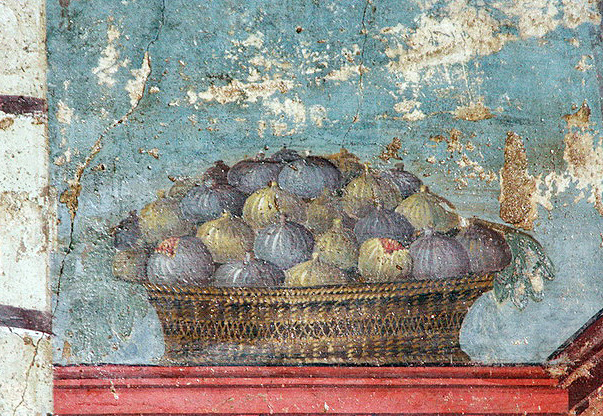
Artists have loved figs at least since Roman times, and there's a rather nice depiction of a basket of them from a fresco in a villa at Oplontis, which I used to show in my Humanities classes to keep my culinary students interested.


Figs are mentioned in numerous ancient texts, from Sumerian tablets to the Bible. I wouldn't be surprised if figs weren't what got Eve in trouble, since they were abundant in the Middle East, whereas apples were not. The Roman cookbook writer Apicius recommends preserving figs in honey, and I'm thinking of trying that by placing a few of my extras in a small jar and covering them with some of the Owens Valley honey we brought back with us in June.

So this is what I've got so far. The results have all been tasty, and easy to produce. But I'm not a recipe person, so you'll have to use your own judgement when it comes to amounts.

Fresh Fig and Almond Tart

I used one Trader Joe's All Butter Puff Pastry roll for this. I stock up on them in the fall when they're available, and use them for making tarts with seasonal fruit. To make this tart, place the pastry on a piece of baking parchment, and brush it with melted butter. Then use a honey-dipper to drizzle honey over that. Quarter enough figs (about 20 small ones?) to cover the top fairly densely, and then drizzle more honey. Sprinkle slivered almonds liberally.


Bake at 400F for about 15 minutes, but check after about 10. It might take as long as 20, depending on your oven. Let cool and cut into six or eight squares. You can also divide the pastry into squares before you put the figs on if you want to feed more people or create a prettier result.

Fresh Fig, Caramelized Onion, and Feta Pizza

Although I preach incessantly about making your own pizza dough, this is high summer in north Texas and my kitchen is not air conditioned. Enter, once again, Trader Joe's, where I can get two very nice organic pizza shells (Monteli Organic) to keep in the freezer for Just Such An Occasion. Do not defrost them; in fact, don't even take them out of the freezer until you're ready to load them up.

You'll also need a large sweet onion, most of a box of real Greek feta in brine (Trader Joe's, Costco, and Whole Foods, as well as most decent supermarkets carry it; pre-crumbled feta is a poor substitute), a few herbs (Provençal herbs work well, but so do thyme and rosemary--fresh if you've got them), and a little balsamic vinegar (optional).

If you're using the Monteli shells, preheat the oven to 420F. If using your usual crust, do whatever you usually do.

Slice the onion thinly, and slowly fry it in butter and/or olive oil until it begins to brown. Add a teaspoon of herbs of Provence, and a teaspoon or two of balsamic vinegar and turn off the heat under the onions.


Quarter a bunch of figs (I truly cannot remember how many I used on each pie, but if you're really concerned about the number, you can count them, above) and set aside. Get the feta out of the fridge, but don't crumble it yet, unless you know about how much you'll need.

Get the pizza shells out, and spread half the onions on each one. Then arrange the figs fairly densely on top, and then crumble the feta over them. 

Place the pies directly on the rack. Cook for about 15 minutes, but check frequently to make sure nothing's burning. The ones I made the other night needed 20 minutes.

This is more or less how they should look:


Fresh Fig and Pecan Muffins

These turned out really well. I combined several generic muffin recipes and came up with these ingredients:
  • 2 cups white whole wheat flour
  • 2 tsp baking powder
  • 1 tsp baking soda
  • 1/2 tsp salt
  • 3/4-1 cup chopped pecans
  • 1/2 cup brown or turbinado sugar
  • 1 egg
  • 1 cup plain yoghurt
  • 3/4 cup avocado oil
  • 1 cup finely chopped figs
Mix all the dry ingredients together thoroughly; in a separate bowl, mix all the wet ingredients (egg through figs) and then add them to the dry slowly, without beating: just enough to incorporate everything. Muffin batter is lumpy by nature, so don't try to make it smooth.


Divide the mixture evenly into twelve muffin cups. It's going to look like a lot, but these don't rise all that much, so you can stuff the cups. Most muffin recipes will tell you to butter the muffin cups if you use them, but I discovered that I had a box of silicone cups that are not only reusable, but they release the muffins beautifully. I sprinkled a little bit of vanilla sugar on each muffin for a little extra flavor burst. A little more brown sugar will work well for that, too.


Bake at 350F for 25 minutes, or until an inserted toothpick comes out clean. These are not terribly sweet, so you can feel really virtuous about eating all that high quality fiber. If you want to enhance the pecan flavor a bit, toast them before you add them to the muffin mixture.


 I still have quite a few figs left over, and will have to either freeze them or use them in something else yummy in the next day or so. I have in mind to try the recipe for Fresh Fig Breakfast Cake from the  Indigo Scones blog, but the results will have to wait.


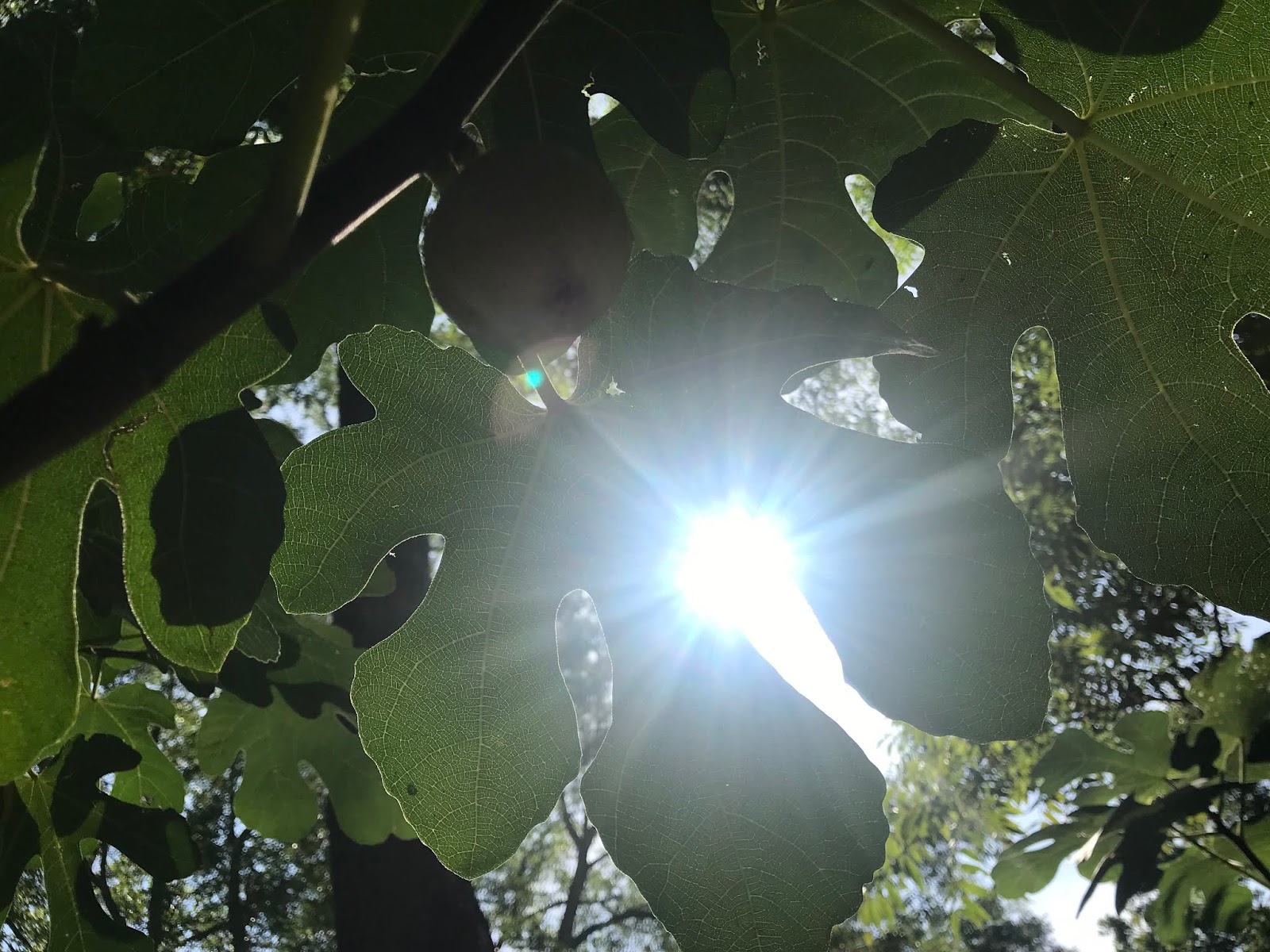
Image notes: all of the photos are mine, except for the Oplonto fresco, which comes from Wikimedia Commons. The opening shot is a cheap excuse to link this post to Skywatch Friday, which I hope everyone who comes here will visit because the weekly sky photos from around the world are terrific.

Thursday, July 11, 2019

Curating One's Life, Part 1


As a result my infrequent, and generally unsuccessful attempts to jumpstart this blog, ideas about potential post topics flit through this old brain like so many bits of paper in a tornado. But I have been thinking lately about the whole process of organizing one's life so that one can, as one ages, make some sense of it. I even got a book for the Kindle app on my iPad to inspire me: Margareta Rasmussen's The Gentle Art of Swedish Death Cleaning (Scribner, 2018). The whole thing is far less morbid than one might expect, and because I'm a natural born snark I love mentioning it to people, and offending their delicate sensibilities.

The truth is, that I'm genetically predisposed to be a gatherer. My mother's name was Hoard, after all, and she lived up to it. And I'm still facing the prospect of going through yet more of her stuff next week as we finally tackle The Great Garage Clean Out. The poor woman has been dead for twenty years and I'm still doing her death cleaning.

Having decided not to put my children through this, I've started tackling small tasks that can help me sort things out in an organized way, and even if my kids don't want to keep my stuff, at least it will be more or less catalogued so that they might be able to fob it off on somebody who actually wants it.

Take my vast collection of past issues of the British Edition of Country Living magazine. My poor husband has been hauling this stash (well, at least the pre-2000 collection; it was mixed in with a complete collection of Martha Stewart Living, until I finally went through those and recycled 90% of the content) every time we've moved since 1988. The first issue I own was bought in London in 1987, and I've been an irregular purchaser ever since. Since 2013 I've subscribed electronically through Zinio, but before then I had amassed 181 issues, including twelve issues of Countryside, an American knockoff that only lasted a couple of years, and to which I subscribed in Chicago until it stopped publication--about four issues after I'd sent in the check.

Now why, you might ask, would an old desert rat, exiled in north Texas, hold such affection for a British shelter magazine when there are more than enough locally relevant publications around here (also available as e-zines these days) to keep any homebody happy. Well there are quite a few, and I subscribe to a number of them, but even those tend to be published in Australia or Canada rather than in the USA, unless they're like Eating Well or holdovers from my hippie days like Mother Earth News and centered on sustainable eating and living.

The thing about Country Living UK, however, is that it has always been focused on stuff I'm a sucker for: rustic design, sustainability, smallholding, countryside, Aga (and other) ranges, Smeg refrigerators, and old creaky houses with personality and a need for TLC.

I once had a dear friend from the Hampshire city of Portsmouth, who thought I was completely bonkers because I had this bizarre (to her) sense of style and taste that meshed far more with the Country Living aesthetic than did her own. She died some years ago, but she would be equally dismayed by my loyalty to the BBC show, "Escape to the Country," watched loyally by the Beloved Spouse and me whenever we can find an episode on YouTube we haven't yet seen.

In my own defense, I have to say that I come by this proclivity genetically. The results of my Ancestry DNA test showed me to be far more British than anything. A smidgen of German and Dutch, but all the rest English, Irish, Scottish and maybe a little Welsh. Even the tad of Scandinavian that showed up in the first go-round (as more data comes in, the picture becomes clearer) has disappeared. (There was a short article in the last update with advice on how to get one's Viking tattoo removed.) And all those Brits mostly went to Canada before they moved south and west, so there's no escaping the Commonwealth.

I'm still trying to locate the origins of some of the ancestors, but have no great urge to find any lost royalty or famous folk. But since they all seem to be from villages rather than cities, I suppose that accounts for my affection for open spaces (although not too heavily treed), and for windy wastes and Thomas Hardy novels.

So today I managed to locate all of the old issues scattered about in bins and cubbies around the house, and have divided them roughly into seasons (Jan-Mar, Apr-Jun, Jul-Sep, Oct-Dec) and will rotate them in appropriate stacks onto the bottom shelf of the stand next to my comfy chair where I can re-enjoy them seasonally and perhaps get inspired to do something other than pine away for the lochs and firths.

My last post extolled the virtues of curatorial apps, and my adventures on Pinterest have been especially helpful. One reason why we'll never have to haul boxes of magazine clippings around again (aside from the probability that we won't be moving anywhere) is that all the inspiring images I used to collect are now neatly housed on some sixty boards sorted into terribly clever and artful categories, able to be consulted on any whim.

That is, at least, until the EMP hits and I spend the rest of my life regretting having tipped all those interesting, inspiring old articles into the recycle bin during the latest spasm of Death Cleaning.

Image note: All of the Country Living issues during the first sort-through. The cat tried to keep me company on the table, but soon left in disgust, all of the bare spots having been taken up by magazines. Taken on the iPhone.