Monday, August 25, 2008

Fiddling Away the Summer

On the same day that I purchased the aforementioned cookbook, I picked up a copy of Neil Gaiman's wonderful kid's book, The Day I Swapped My Dad for Two Goldfish, illustrated by Dave McKean. There's something charming about these post-David Carson illustrated books, with their grungy disregard for the former proprieties of children's illustrations. We can lay some blame for this--if that's what's required--at the feet of Georges Braque, Marcel Duchamp, Joseph Cornell, Robert Rauschenberg, and others who taught us that collage is a legitimate art form, and on David Carson and April Greiman, among others, who taught us that we didn't have to take type at face value. We can, in fact, mess with it.

As much as I love all the artful tomfoolery that gave us Eric Carle's The Very Hungry Caterpiller (or, as my children used to call it, The Vey Hungey D-r-r-r-r), I still remember fondly Walter Crane and his many imitators, and their engaging drawings in books I inherited from my mother, and even my grandmothers. So when, in the process of sorting through decades worth of accumulated miscellanea (as part of the guest-room conversion project), I came upon some of these books, I decided to share them here.

The first is The Story of Silky, by Jasmine Stone van Dresser, with pictures by Clarence Biers and Joan Harman (originally published by Rand McNally in 1924; mine is the 1938 edition, so I don't know who it originally belonged to). The story is a bit silly, but both "Silky" and another story, "The Kitty With the Black Nose," contain lessons about diversity, of all things. The pictures are derivative, as are most from the '20s, of Aubrey Beardsley and Walter Crane, but are not without their own charm.

The second, in what looks from the cover background to be from the same series of Rand McNally books as "Silky," is called Loraine and the Little People of Summer, by Elizabeth Gordon and illustrated by James McCracken (originally published in 1920, but reprinted in 1936). It's inscribed to my mother from her mother (Mummy would have been about 10). I was especially fond of fairy stories when I was little, so I can see why this would have been one of my favorites. Again, the pictures owe a great deal to the Art Nouveau sensibilities still making the rounds. Gordon, according to my research, wrote another Loraine book, involving the Little People of the Ocean.

Finally, my favorite of all: John Rae's Grasshopper Green and the Meadow-Mice, published by P. F. Volland Company whose wonderful logo can just be seen on the back cover, in 1922 (mine is the 16th edition). The front cover appears at the beginning of this post. The story is a marvelous riff on the Aesop fable about the grasshopper who fiddled away the summer and was then turned away by industrious ants. "Now you've probably wondered, just as I used to, whatever finally became of that Grasshopper," says Rae. And off he goes. It turns out to be a story of redemption and friendship--and once again about diversity. Who'd have thought? To top it all off, the whole book, complete with illustrations, is available through the link, thanks to Project Gutenberg.

I was apparently still reading the book when I was in high school, because I recorded my grades in the back. That tells me two things. First, I was rather careless about where I wrote things (it's really an odd place to be writing down Freshman grades), and second, that it might well have belonged to my Uncle Art, since it would have been at Grandma Clarice's that I first read it.

The archaeology of childhood can be extremely revealing. I associate all of these books with places--the first two in Oregon, the last in the Owens Valley--which surprises me little. But they also reflect something about where my values come from: concepts of community, experiences of friendship, and even my aesthetic sensibilities.

I don't have any grandchildren on the horizon. But I do have friends with young children, and when they come to visit, I'll make sure that Grasshopper Green and the Meadow Mice is every bit as accessible as The Day I Swapped My Dad for Two Goldfish.

Saturday, August 16, 2008

Mrs. Rudkin's Cookbook

One of the problems with having multiple blogs, even when they're focused on different topics, is that sometimes I'm not sure where to post something. This conundrum arose yesterday when I came across a wonderful book about which I wanted to make note--but couldn't choose the proper venue. This morning I decided to post it on both. This sounds a bit lazy, but since it's the product of a serendipitous occurrence and about the idea of home and place, maybe the idea isn't as silly as it seems even as I write.

The book in question is The Margaret Rudkin Pepperidge Farm Cookbook, illustrated by Erik Blegvad, and published by Atheneum in 1963. I found it in the "nostalgia" section of Half Price Books yesterday, where I'd gone to drown my sorrows after hearing about the resignation of a friend and colleague--the second in as many months--which left me feeling more than a little bereft. Beloved Spouse and I were on our way out when I noticed the rather Edward Gorey-ish spine of a book which, on first glance seemed to be another corporate promotional endeavor (some of which, like the Spice Islands Cookbook, also published in 1963, can be quite good)--but with amusing and well-crafted pictures scattered throughout. The dust jacket was missing, so what attracted me were the un-augmented images on the front (above) and back (below) covers.

Now, I'm as big a sucker for good illustration as I am for good cookbooks, so I said to myself, "What the hell; it's only ten bucks" and added it to my small pile of goodies.

When I got home, I started leafing through the book and discovered a treasure: a compendium of healthful recipes developed by the woman who had founded Pepperidge Farm (named for her own family's farm in Connecticut) and ended up serving on the board of Campbell Soup after she sold her company to them in 1961. In 2007, Fortune Magazine named her one of the century's fifty most powerful women. (Copies of the cookbook can be had from online used-book outlets like alibris for less than what I paid, but some may be the 1992 edition).

Margaret Fogarty Rudkin was born the same year as my Grandma Clarice, 1897, in New York. In 1937, when her son developed allergies that his doctor said could be addressed by feeding him bread made from whole grains, she began a journey that eventually led to the cookbook. 1963, when Rudkin published it, was the year after I returned from Taiwan and during which I lived with my grandmother, so the coincidence adds to my delight in finding the book when I did.

The illustrator, Erik Blegvad, is actually no stranger to my family. One of my children's favorite books growing up was Judith Viorst's The Tenth Good Thing About Barney (which I highly recommend to families for helping them deal with the death of a pet)--illustrated by none other than Mr. Blegvad.

During my recently aborted attempt to improve my typographic skills (I had to drop the class because midterm madness caught up with me), I had run across another book by Blegvad that's probably worth looking for: Types Best Remembered/Types Best Forgotten, published by Parsimony Press in 1994. But the cheapest edition I could find through alibris is $69. Guess I'll wait on that one.

At any rate, owning Rudkin's cookbook is really like having several books in one, because each chapter focuses on an entirely different topic: Childhood, Country Life, Pepperidge Farm, Cooking from Antique Cookbooks, and Ireland. Each features a chatty and informative introduction, and the "antique cookbooks" chapter offers modern versions of such goodies as a fifteenth-century pumpkin pie, although the original carries this warning: "Cassius, who was bothered by colic and stones, did not eat this. It is difficult to digest and nourishes badly." Rudkin's version is much more palatable (perhaps because she doesn't put in a half pound of sow's belly), and simple to make:

Preheat oven to 450.

Ingredients: (Plain pastry for a 9 inch single-crust pie.) 1.5 cups canned pumpkin, 2/3 cup brown sugar, 1 tsp. cinnamon, 1/2 tsp. ginger, 1/2 tsp. salt, 2 eggs, 1 c. milk, 1 c. cream.


Method: Line a 9-inch pie pan with pastry, making a high edge. Brush the pastry all over with egg white. Place in the refrigerator while preparing the filling. Mix together the pumpkin and the spices. Sift the brown sugar into the pumpkin and mix well. Beat the eggs and add them. The add the milk and cream and mix well.
Pull out the shelf of the oven, set the prepared pie pan on the shelf and carefully pour the filling into the crust. Don't pour all onto one spot., but take a cupful at a time and spread the filling around to avoid breaking the crust. Filling the crust this way avoids spilling.

Bake at 450 F for 10 minutes, then reduce heat to 350 and bake 45 minutes more until the custard is set.


The idea of simple food, lovingly prepared is always welcome, but I think we can especially appreciate it in times when folks no longer eat together all that often, and when grandmothers and their grandchildren can be separated by continents. My memories of times in my grandmother's kitchen come flooding back when I find a book like this, grounded in a similar view of the world and a similar notion of nurturing. My fondest wish is that more people come back to the practice of spending time cooking together as gas gets more expensive and makes folks less likely to run out to the Olive Garden for a family meal. There is absolutely nothing like a home-made pumpkin pie to make us feel secure and comfy--and nothing like a well-illustrated, well-written cookbook to help us recall the relationship between food and home.

Friday, August 8, 2008

Heavenly Visions

While I was preparing an augment for this week's History of Art & Design II lecture on the Fin de siècle, I spent some rather enjoyable hours looking through various sites that offer images of natural history illustration in the late nineteenth century. I'd already been inspired by the Haeckel book mentioned on my last post, and in addition to the various pages devoted to his work, I also happened on the New York Public Library's Digital Image Library and its collection of drawings by the French astronomer Étienne Léopold Trouvelot (1827-1895). The images are of chromolithographs produced from drawings Trouvelot made while observing such heavenly bodies as the moon and Mars.

The drawing of the moon is quite fanciful and suggestive of the Art Nouveau designs that would shortly follow in France, England, Austria, and other parts of the Continent:

A crater on the moon was later named after Trouvelot:

Compare Trouvelot's almost floral interpretation with Galileo's drawing of what he saw, alongside a photo of the spot:
Trouvelot's image of Mars almost suggests an embryo, but it's quite simple to understand how he came to his conclusions about what his telescope showed him, because I get an image close to this when I look through my very basic backyard model:

The drawing records his observation at a precise moment: September 3, 1877, at 11 hrs. 55 min. P. M.

My favorite image Wunderkammer, Wikimedia Commons, produced some interesting and varied finds under the general rubric of science illustration. You really need to search using "science" as your keyword, because the illustrations show up under general topics such as "biology" (which would eventually lead you to Haeckel) or "astronomy." Looking through the Commons catalogue under "armillary sphere" in "history of astronomy" (under "astronomy"), for example, produced a lovely scan of Utagawa Kinuyoshi's Chinese Astronomer 1685. When it ran as Wikimedia's "Picture of the Day" it proved to be so popular that it was nominated for "Picture of the Year" for 2006.

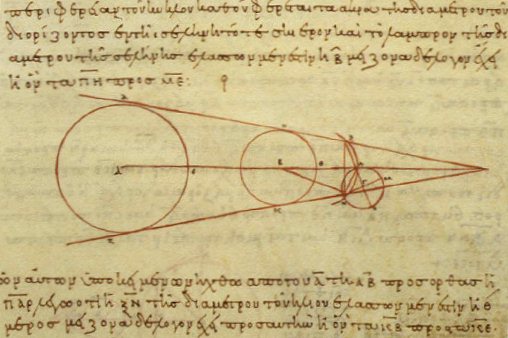
There are also numerous diagrams from periods throughout history. These are often simple, elegant, and accurate--especially considering the lack of all the technological bells and whistles we have access to today. One of these is a 10th century CE Greek copy of calculations made by Aristachus of Samos (in the second century BCE) of the relative sizes of the sun, moon, and Earth:

Another drawing, by the Arab astronomer Nasir Al-Din Tusi, illustrates what's now known as a Tusi-couple, used to depict an aspect of planetary motion that Ptolemy described in his convoluted equant theory. Together with its clarity, and the elegance of the Arabic script, it combines calligraphic elements that exemplify good solid graphic design principles still in place.

I should probably end with what was one of my favorite discoveries of all--Tito Lessi's painting of Galileo and Viviani from 1892.

It's a wonderful emblem of the interest in science evident in nineteenth-century Europe that had a huge impact on the development of art and design, especially in terms of subject matter. I only hope that by introducing my students to the existence of this fascination they can play around with some of these sources and makes some discoveries of their own.

Photo credit: in addition to the images I've already credited, the first one I include is Universum, a montage by Camille Flammaron for the 1880 edition of his work, Popular Astronomy.

Monday, July 21, 2008

The Encyclopedia of Life

My interests are pretty wide-ranging, and they include the natural world in general, and the interactions between geology and biology in particular. In fact, I was once enrolled in a graduate program to acquire credentials to teach earth and life sciences to middle schoolers. Anyway, by an odd progression of chances while I was checking out web sources on conceptual typography (!), I ended up reading the Chronicle of Higher Education's article about The Encyclopedia of Life. This ambitious project to catalogue all of earth's species (disappearing at an alarming rate as we speak), is described on the home page as "an ecosystem of websites that makes all key information about all life on Earth accessible to anyone, anywhere in the world." Right up my little collectivist alley.

I was drawn to the article in the first place by the fact that it was illustrated in the print edition of the Chronicle (I subscribe on the web, but often read the print copy in the library) by one of Ernst Haeckel's drawings--the very same Haeckel I'd blogged about a couple of weeks ago. This image, of Aulacantha scolymantha, from his 1862 monograph on radiolaria, was obtained by the Encyclopedia from a truly wonderful web page called Micro*scope: yet another discovery to make a frustrated bio-geologist's day. This site represents another collaborative effort and provides information and images on all manner of microbial life; it's also collaborative, and partnered with the EoL. If you register, you can get access to terrific (I think, anyway) screensavers, and a massive number of images like this one of a colonial radiolarian (say that three times quickly), by Dave Caron of the University of Southern California:

Now, I'm no marine biologist, but I love this stuff! I can't help but think that studying the incredible variety of forms available in nature would be useful and instructive to artists and designers everywhere.

The Encyclopedia of Life and its partners promise to bring together a Wunderkammer of information and images about the species on this planet. And if you want an idea of how bloody lucky we are to be here in the first place, take a gander at the National Geographic Channel's series, Earth: The Biography. Host Iain Stewart (terrific Scots accent), with the help of magnificent NatGeo footage, not only shows us where we come from, but how many chancy factors are involved. If more people understood these things, and knew more about what's at risk if we screw it all up now, perhaps our grandchildren would have a chance to enjoy it, too.

Addendum, 22 July: It occurs to me that I neglected to mention one important point. The perpetrator of the Encyclopedia of Life project is none other than E. O. Wilson, biologist extraordinaire and my favorite ant guy. He invented the field of sociobiology, out of which came one of my favorite books: Biophilia. He's gone a bit cranky in his old age, hankering as he is now for the Enlightenment, but his newer book, Consilience, is still a good read--especially for those of us somewhat sympathetic to his views. More summer reading, for the biodiversity-inclined.

Saturday, July 19, 2008

Joss Whedon's At It Again

This just in (and only available until Sunday night): Joss Whedon's latest effort. Those of us who worship at the feet of the master are having enormous fun with this little curiosity, so do take the opportunity to check it out. Dr. Horrible's Sing-along Blog is an online musical miniseries starring Nathan (Mal Reynolds) Fillion and Neil Patrick (Doogie Howser) Harris, along with Felicia Day as the love interest. Nicely produced by Mutant Enemy (you know, the "Grrr. Argh" guys who brought us Firefly) and just plain fun, it's well worth several minutes of your time. And it's why I'm not posting any more today, because I need to get the whole thing watched.

It'll be back (see the Master Plan), but this is apparently it for now.

Monday, July 14, 2008

Angles of Repose

One thing always seems to lead to another, and its this serendipity factor that I enjoy most about living in the rarefied aether of the blogosphere.

Today, for example, I had no intention of posting here in the Cabinet. But I wanted to touch base with some of the blogs I frequent (I don't have automatic feeds to any of them, because there's already too much stuff to attend to in the various e-mail accounts), and went first to Serenity Now, another web Wunderkammer that originates not all that far north of me. Christie has been talking about fireflies and what to do with roosters, and after I'd posted comments I did what I often do: glanced at other commenter's blogs.

There I discovered Sweet Repose, where "lives" a retired Iowa antiques dealer who had recently posted on chamber pots. After leaving a small reminiscence there, I started musing on the blog's title, and this old gal's mind wandered to--Wallace Stegner's Pulitzer Prize-winning novel, Angle of Repose, which I read last summer, not long after having re-read the late Ellen Meloy's The Anthropology of Turquoise. Meloy was a long-time Stegner fan, and all three of us share California connections--although mine involves a different side of the Sierras than either of theirs do. Meloy died young, but not before writing several really evocative books about western wilderness. Stegner, during his stint as the director of Stanford's creative writing program, influenced the likes of Wendell Berry, Edward Abbey, Ken Kesey, and Larry McMurtry. For more of my take on related topics, see my Owl's Farm post from last year, "Writing the Desert."

I should mention that I'm not reading much fiction these days (except for good hard science fiction), but I became so absorbed in Stegner's book that I ended up doing a bit of research on the inspiration for the novel: the life and work of Mary Hallock Foote. There's a nice profile of Stegner on the California Association of Teachers of English site, and it succinctly describes the controversy that arose over Stegner's use (with the permission of her granddaughter) of Foote's letters as the basis for his novel. Although fiction, the accounts of Susan Burlington Ward's experiences as a turn-of-the-century eastern Quaker in the American west (grounded as they are in Foote's actual life) resonate with what my grandmother described about living in California's Owens River Valley in the early twentieth century. At any rate, what emerges from the confluence of the novel and what I learned about Foote is further confirmation that other people's lives overlap in unexpected ways to enrich our own when we're paying attention.

Were my grandmother and my father still alive, the books I list below would have been taken home during my then-annual pilgrimages back to the valley and offered up enthusiastically on the family literary altar for reading and later conversation.

In their memory, my Summer Reading Recommendations, for anyone interested in topics like desert ecology and life, the history of mining in the West, the history of California, Victorian women in the west, and some damned good writing, are as follows:

Wallace Stegner, Angle of Repose.
Ellen Meloy, The Anthropology of Turquoise
Rodman W. Paul, A Victorian Gentlewoman in the Far West: The Reminiscences of Mary Hallock Foote (Huntington Library, 2003)

Online resources:

Mary Hallock Foote
Ellen Meloy
Wallace Stegner and the text of his Wilderness Letter

I hope you've got a good hammock in your back yard, and a large supply of cold-brewed iced tea.

Photo: A Hammock, by Dennis Mojado. Wikimedia Commons

Friday, July 11, 2008

The Medieval Garden Enclosed

I remarked to a colleague during a meeting this week that the only people who read blogs are those who write them--or who are related to the bloggers. But occasionally I come across a blog that needs to be shared because it has worth beyond the blogosphere, and the Metropolitan Museum of Art's new effort, The Medieval Garden Enclosed is one of these.

The Cloisters Museum and Gardens at the Met are among its most popular exhibits, in part because medievalism enjoys frequent revivals in popular culture, but mostly because of the Unicorn Tapestries and the gardens. The exhibit itself is an exercise in virtual reality, with its reconstructed Romanesque enclosures, and the variety of works that transport us back to the Middle Ages. I've spent a good deal of my adult life studying the effects of medievalism on the development of modern art, and the Cloisters is always my first stop whenever I get to New York. Since I don't get there much any more, this blog will provide a nice touchstone.

The most recent posts are on lavender, an herb that grows beautifully here in Texas (even though I don't have much success with it), and is the best sleep-inducer of all time.

I look forward to reading the blog regularly, not only for its inside view of the Cloisters exhibit itself, but for the practical advice on medieval herbs and plants--a topic many of us just can't get enough of.

Photo: the Cuxa Cloister Garth Garden, nicked from the blog.